
 EN
EN


A screwdriver replacement bit is a small component with a direct impact on fastening quality, tool reliability, and assembly efficiency. In automotive maintenance, machinery manufacturing, electronics assembly, construction, and general industrial maintenance, the wrong bit can cause screw-head damage, premature bit wear, inconsistent torque transfer, and production downtime. Even when a bit fits the nominal screw type, differences in dimensional accuracy, material hardness, tip geometry, and manufacturing consistency can significantly affect performance.
Selecting a screwdriver replacement bit therefore requires more than matching a Phillips, slotted, Torx, or hex profile. The application determines the required tip geometry, working length, material properties, surface treatment, and compatibility with the tool holder. A bit designed for occasional manual repairs may not withstand the repeated impact loading of a powered screwdriver, while a high-hardness bit may still fail prematurely if its tip geometry or heat treatment is poorly controlled.
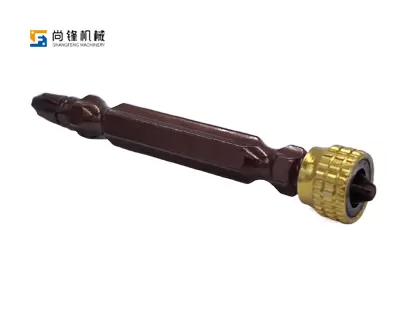
Shangfeng Machinery Co., Ltd. specializes in screwdriver bits, ratchet screwdrivers, nut sockets, bit holders, quick-change devices, and screwdriver bit sets. Its manufacturing capabilities include automated tool production equipment, precision inspection equipment, and a Taiwan-origin cold-forging process. The company produces screwdriver bits and related accessories according to DIN and ANSI standards, providing a relevant foundation for evaluating bit quality in demanding fastening applications.
Tip Profile and Screw Compatibility
The tip profile is the first specification to confirm when choosing a screwdriver replacement bit. Common profiles include Phillips (PH), Pozidriv (PZ), slotted, Torx, hex, and other application-specific designs. These profiles are not interchangeable simply because they appear similar or fit loosely into the screw recess.
Phillips bits are commonly used in general assembly and maintenance. Their geometry is designed around a cross-shaped recess, but incorrect sizing or poor engagement can cause the bit to ride out under load. Pozidriv profiles include additional contact features and should be matched with the corresponding screw recess rather than substituted with a Phillips bit. Using the wrong profile can reduce contact area, damage the recess, and increase the likelihood of cam-out.
Torx bits use a six-lobed profile that can provide effective torque transmission when the bit and screw are correctly matched. They are widely used in automotive components, machinery, appliances, and equipment maintenance. Hex bits are frequently used with socket-head fasteners, while slotted bits remain relevant in electrical work, maintenance, and applications using conventional slotted screws.
The nominal profile alone is not enough. Size matters because an undersized bit may concentrate contact forces on a limited area, while an oversized bit may fail to enter the recess correctly. In either case, the result can be damaged fasteners and unstable fastening performance. For high-volume assembly, the bit size should be validated against the actual screw supplier's specifications and the operating conditions of the tool.
For applications involving multiple fastener types, a clearly identified bit inventory reduces selection errors. Markings should distinguish profile and size, such as PH2, PZ2, T25, or H5, using the appropriate notation for the product range. Clear identification is especially valuable when bits are stored in shared tool cabinets or changed frequently on production lines.
Material Selection and Hardness
A screwdriver replacement bit must resist torsional stress, contact pressure, and repeated loading at the tip. Material composition and heat treatment determine how the bit balances hardness, strength, toughness, and wear resistance.
Alloy tool steels are commonly used in screwdriver bit production because they can be processed to achieve the mechanical properties required for fastening tools. However, the steel grade alone does not guarantee performance. Heat-treatment temperature, quenching, tempering, and process consistency influence the final structure and mechanical behavior of the material.
Hardness helps a bit resist surface deformation and wear, but maximum hardness is not always the best choice. A very hard tip may resist wear yet become more vulnerable to chipping under sudden impact or misalignment. A bit with insufficient hardness may deform more quickly, losing its original profile and reducing engagement with the fastener.
The appropriate balance depends on the operating mode. Manual fastening usually involves relatively controlled loading, while powered screwdrivers can apply repeated torque cycles. Impact drivers introduce more severe and rapidly changing loads, so bits intended for impact use should be specifically designed and tested for that purpose. A conventional bit should not automatically be assumed suitable for impact driving merely because it fits the holder.
Manufacturers should assess hardness alongside dimensional accuracy, torsional performance, and tip durability. For critical applications, batch-level quality records and representative performance testing provide stronger evidence than a hardness value alone. Consistent heat treatment is particularly important for maintaining predictable performance across large production volumes.
Why Cold Forging Matters in Bit Manufacturing
Cold forging is a forming process that shapes metal under controlled conditions without heating the workpiece to conventional hot-forging temperatures. In screwdriver bit manufacturing, an appropriate cold-forging process can support dimensional consistency and efficient production of the bit's working geometry.
The quality of the finished product still depends on the complete manufacturing route. Material preparation, forming accuracy, machining where required, heat treatment, surface finishing, and final inspection all influence the performance of the finished bit. Cold forging should therefore be understood as one part of a controlled production process rather than a guarantee of quality by itself.
For a screwdriver replacement bit, the tip profile and shank dimensions must remain within the specified tolerances. Variation in the working end can affect screw engagement, while variation in the shank can cause problems with holder compatibility or retention. In powered applications, poor concentricity or inconsistent geometry may also contribute to vibration and uneven loading.
Shangfeng Machinery uses a Taiwan-origin cold-forging process and automated production equipment for its tool products. When evaluating a supplier using this process, it is useful to confirm the manufacturing specifications, inspection methods, and acceptable dimensional tolerances for the required bit range. Samples should be tested with the actual screws and holders used in the intended application.
Length, Shank Design, and Holder Compatibility
Bit length is a functional specification, not merely a packaging detail. Short bits can provide a compact and rigid connection for general fastening, while longer bits help reach recessed screws, deep housings, and confined installation points. However, increasing length can increase bending sensitivity under side loading and may reduce practical control in certain applications.
The correct working length depends on access requirements, screw location, and the geometry of the tool. A long bit used in a deep assembly may be necessary to reach the fastener, but excessive length should be avoided when it offers no practical benefit. Operators should keep the bit aligned with the screw axis because side loading increases the risk of tip damage and screw-head stripping.
Shank compatibility must also be confirmed. Many powered tools and bit holders use standardized hex shanks, including common 1/4-inch hex interfaces, but not every bit, holder, or quick-change system has identical retention characteristics. The specified shank geometry, overall length, and locking mechanism should be checked against the tool manufacturer's requirements.
A magnetic bit holder can improve convenience when handling small screws, especially in maintenance or overhead assembly. However, magnetic retention is not a substitute for correct bit-to-screw engagement, and magnetism may not be appropriate for every application. Quick-change holders are useful where operators need to switch between bit profiles frequently, provided the locking mechanism retains the bit securely under the expected operating conditions.
Torque Transfer, Wear, and Common Failure Modes
Premature screwdriver bit failure often results from a combination of incorrect selection, excessive torque, misalignment, and unsuitable operating conditions. A worn or damaged tip can slip in the screw recess, generating additional friction and damaging both the bit and the fastener.
Cam-out is particularly common when the bit profile or size does not match the screw, or when axial pressure is insufficient for the application. The resulting movement can damage the recess and create a safety risk if the tool slips unexpectedly. Using the correct bit and maintaining alignment are therefore essential even when the tool has a high torque rating.
Torsional failure occurs when the stress applied to the bit exceeds its capacity. Excessive torque, impact loading, material defects, or a weakened cross-section can contribute to fracture. A bit that is not designed for impact driving should not be used in that mode without supporting specifications or test evidence.
Wear should be evaluated through the condition of the tip, not just the appearance of the shank. Rounded edges, deformation, chipped corners, or reduced engagement can indicate that the bit should be replaced. Continuing to use a worn bit may increase screw damage and assembly inconsistency, ultimately costing more than timely replacement.
For automated production, bit life can be tracked by fastening cycles, defect rates, or scheduled inspection intervals. The appropriate replacement interval depends on screw material, torque settings, tool type, fastening frequency, and the consequences of a failed joint. A controlled replacement policy helps reduce unexpected downtime and prevents degraded bits from remaining in service.
Standards, Inspection, and Supplier Evaluation
DIN and ANSI standards provide important reference points for tool dimensions and related requirements, but the exact standard depends on the product type and specification. Buyers should confirm which standard applies to the requested bit and whether the supplier's declared compliance covers the relevant dimensions and performance characteristics.
A useful supplier evaluation considers dimensional inspection, material traceability, heat-treatment consistency, surface quality, and functional testing. Inspection equipment should be appropriate for the features being controlled, including the bit profile, shank dimensions, and overall length. Where the application is critical, samples should undergo practical fastening trials using the actual screw, holder, and tool configuration.
Shangfeng Machinery reports using precision inspection equipment and manufacturing products according to DIN and ANSI standards. The company also holds BSCI certification, which relates to social compliance in the supply chain rather than directly certifying bit performance. These factors can support supplier assessment, but the final qualification should be based on product-specific technical data and verification.
For bulk orders, agreed acceptance criteria can reduce misunderstandings. The specification should identify profile, size, length, shank interface, material or performance requirements, surface treatment, packaging, and applicable inspection standards. Consistent labeling and batch identification also help maintain traceability during storage and replenishment.
Conclusion
Choosing the right screwdriver replacement bit requires a coordinated assessment of tip geometry, material properties, heat treatment, length, holder compatibility, and actual fastening conditions. A bit that matches the screw profile and maintains dimensional consistency can improve torque transfer, reduce fastener damage, and support more predictable tool life.
For industrial applications, the most effective selection process combines clear specifications with representative testing. Verify compatibility with the actual screw and tool, confirm whether the bit is intended for manual, powered, or impact use, and evaluate quality controls that support repeatable production.
With its range of screwdriver bits and related accessories, cold-forging capabilities, automated production equipment, and precision inspection processes, Shangfeng Machinery offers a manufacturing base for evaluating application-specific bit solutions. The final decision should be guided by measurable requirements and verified performance rather than nominal profile or purchase price alone.