
 EN
EN


Bulk sourcing ratchet wrenches involves more than comparing unit prices and catalog specifications. The final cost of a tool is influenced by mechanical reliability, machining consistency, material utilization, surface treatment, inspection requirements, packaging, production capacity, and the number of defective units that enter the supply chain.
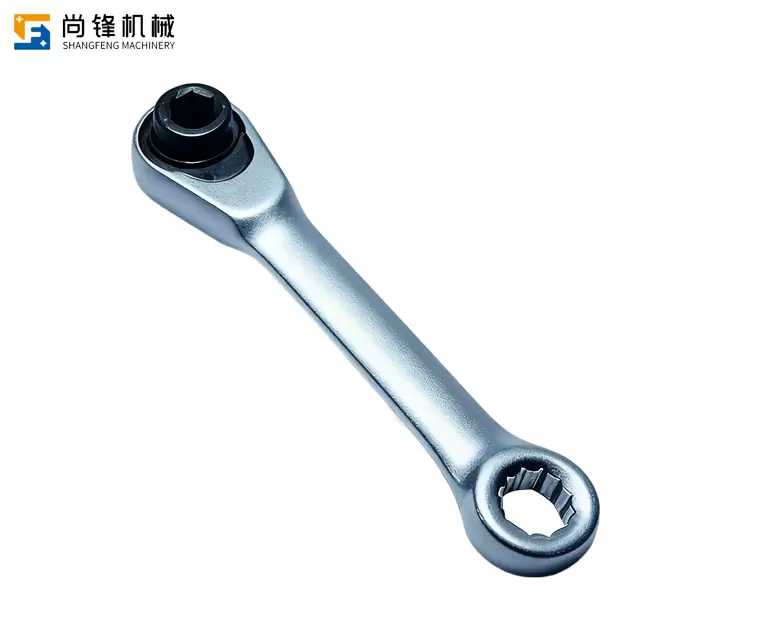
For buyers evaluating a ratchet wrench manufacturer China, supplier qualification should therefore focus on the manufacturer's ability to repeatedly produce the same mechanical performance at commercial scale. A sample that performs well during initial evaluation is useful, but it does not prove that thousands or tens of thousands of units will maintain the same tolerances and torque characteristics.
Start With a Clear Mechanical Specification
Before requesting quotations, the product specification should define the intended use and critical performance requirements.
Drive size, wrench dimensions, tooth count, swing arc, torque range, material, hardness, surface finish, handle design, and applicable standards should be established according to the application.
For example, a 1/4-inch drive ratchet intended for electronics or light automotive work has different load requirements from a 1/2-inch drive ratchet intended for heavy automotive maintenance.
Similarly, a 72-tooth mechanism may provide a 5° swing arc, while a 90-tooth mechanism provides approximately 4°. The smaller swing angle can improve accessibility, but the mechanism must still provide adequate load capacity and durability.
A good supplier should be able to explain the relationship between these parameters instead of simply recommending the most expensive configuration.
Evaluate the Gear and Pawl as a System
The gear and pawl carry concentrated mechanical loads. Their interaction determines whether the ratchet locks reliably under torque.
The tooth profile must provide sufficient engagement without creating unnecessary friction during free movement. The pawl must engage consistently and remain stable under load.
Spring force also matters. If the spring is too weak, engagement reliability may decrease. If it is excessively strong, switching and operating feel may be affected.
These components should therefore be evaluated together rather than as independent parts.
During supplier qualification, functional testing should include direction switching, engagement consistency, free rotation, abnormal noise, and torque loading.
Material and Heat Treatment Require Traceability
Steel selection establishes the potential mechanical performance of the tool, but heat treatment determines how much of that potential is realized.
Important controls may include furnace temperature, holding time, cooling method, hardness range, and batch traceability. The exact treatment depends on the selected steel and component design.
A manufacturer should be able to provide material documentation and appropriate inspection records when required. Hardness measurements can help verify treatment consistency, but hardness should not be considered a complete substitute for functional torque and durability testing.
A ratchet mechanism can have acceptable hardness while still suffering from poor geometry, insufficient toughness, or improper assembly.
Cold Forging Can Improve Production Efficiency
For suitable components, cold forging can reduce material waste and improve production efficiency by forming near-net-shape parts before subsequent machining.
The process can also provide favorable material flow and reduce the amount of material that must be removed during finishing operations.
Shangfeng Machinery Co., Ltd. has introduced automated tool manufacturing equipment and high-precision inspection equipment and uses Taiwan cold forging technology for its tool-related products.
For large orders, this type of production capability can help maintain dimensional consistency while supporting higher-volume manufacturing.
However, cold forging should not be treated as a guarantee of quality. Tooling accuracy, lubrication, material condition, forming parameters, subsequent machining, and inspection remain essential.
Inspect Critical Dimensions Instead of Measuring Everything Equally
A common mistake in supplier qualification is to demand extremely tight tolerances for every dimension.
This can increase manufacturing costs without necessarily improving product performance. A better approach is to identify critical-to-function dimensions.
For a ratchet wrench, these may include gear-to-pawl engagement geometry, drive interface dimensions, retaining features, component clearances, and selected handle dimensions.
Inspection equipment should then be selected according to the required accuracy. Dimensional gauges, calipers, micrometers, hardness testers, torque testers, and other instruments may be used depending on the component and specification.
The objective is to create a measurement system that detects meaningful variation rather than simply generating large quantities of inspection data.
Surface Finish Should Match the Application
A ratchet wrench may be offered with polished chrome, satin chrome, black oxide, or other finishes.
The choice affects appearance, corrosion resistance, cleaning behavior, grip characteristics, and production cost.
Workshop environments may expose tools to oils, moisture, dirt, and cleaning chemicals. A surface treatment with appropriate corrosion resistance can help maintain appearance and serviceability.
For products positioned in professional tool ranges, consistency of plating or finishing is also commercially important. Visible variation between batches can lead to customer complaints even when mechanical performance remains acceptable.
Test the Product After Assembly
Component inspection is necessary, but the final assembled ratchet wrench must also be tested.
Assembly introduces additional variables such as spring positioning, pawl engagement, retaining-component installation, lubrication, and mechanism alignment.
A component can individually meet its dimensional specification while the assembled mechanism still produces excessive play or poor switching performance.
Functional inspection should therefore be performed on the finished tool. Depending on the product specification, this can include ratcheting operation, direction switching, torque testing, free rotation, and visual inspection.
For large-scale orders, sampling plans should be agreed in advance so both sides have a clear understanding of acceptance criteria.
Production Capacity Is More Than Monthly Output
A supplier may state a high monthly production capacity, but capacity alone does not demonstrate that the manufacturer can maintain quality during a large order.
The more useful questions concern bottleneck processes. Can the supplier maintain stable forging output? Is heat treatment capacity sufficient? Are machining and finishing processes synchronized? Can inspection keep pace with production? Is there enough tooling and maintenance capacity to prevent production interruptions?
A factory with automated equipment but insufficient inspection capacity may still struggle to maintain stable output.
For repeat orders, production planning and quality control need to scale together.
Packaging and Logistics Can Affect Final Cost
Ratchet wrenches are relatively robust products, but inappropriate packaging can still cause surface damage, corrosion, or component mixing during transportation.
Packaging should protect the finish and prevent tools from striking each other during handling. Product identification, carton quantity, labeling, and pallet configuration should also be standardized for large shipments.
For export orders, the total sourcing calculation should include packaging, inspection, transportation efficiency, and potential replacement costs—not simply the ex-factory unit price.
Why Supplier Manufacturing Capability Matters
A reliable ratchet wrench manufacturer China should be able to connect raw materials, forming, machining, heat treatment, assembly, inspection, and packaging into one controlled manufacturing system.
Shangfeng Machinery has experience in screwdriver bits, ratchet screwdrivers, sockets, bit holders, quick-change devices, and screwdriver bit sets, supported by automated production equipment, high-precision inspection equipment, Taiwan cold forging technology, and DIN and ANSI-oriented manufacturing practices. Its BSCI certification also provides an additional reference point for supply-chain qualification.
For buyers developing private-label or long-term tool programs, this type of integrated capability can be more valuable than a low initial quotation because it supports repeatability across production batches.
Conclusion
Bulk sourcing from a ratchet wrench manufacturer China should be treated as a technical supplier-qualification process. The most important factors include mechanical design, gear and pawl engagement, material traceability, heat treatment, forming technology, critical dimensional control, surface treatment, finished-tool testing, production capacity, and packaging.
The strongest supplier is not necessarily the one offering the lowest unit price. It is the manufacturer capable of converting an agreed specification into stable mass production, maintaining functional performance from the first batch to subsequent repeat orders, and providing the inspection evidence needed to support long-term supply.