
 EN
EN


A ratchet wrench is a relatively compact hand tool, but its performance depends on a combination of mechanical design, material selection, heat treatment, machining accuracy, surface finishing, and assembly control. For buyers sourcing from a ratchet wrench manufacturer China, the key question is not simply whether the wrench looks well finished. The more important issue is whether the manufacturer can maintain consistent torque transmission, reliable ratcheting, dimensional accuracy, and service life across large production batches.
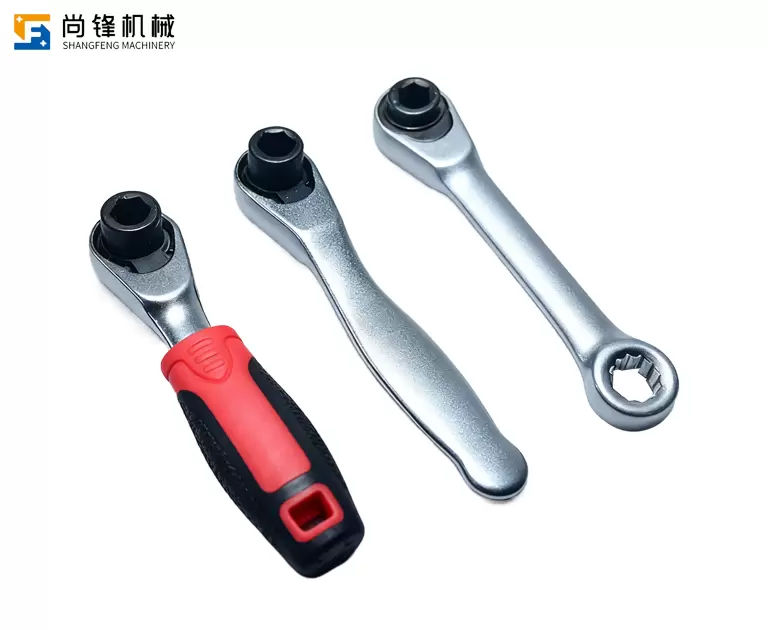
This becomes particularly important for automotive repair, industrial maintenance, machinery assembly, construction equipment, and professional tool sets. In these applications, a ratchet wrench may be subjected to repeated torque cycles, contamination, impact loading, and continuous handling. A manufacturing process that controls only appearance can therefore produce a tool that looks premium but performs inconsistently under load.
Ratchet Mechanism Precision Determines Operating Quality
The ratcheting mechanism is the functional center of the wrench. It converts a small back-and-forth handle movement into controlled rotational movement while allowing the user to reposition the tool without removing it from the fastener.
The mechanism normally includes components such as the gear, pawl, selector, spring, and retaining structure. Their dimensional relationship directly affects the tool's backdrag, engagement, direction switching, and load-bearing behavior.
A finer-tooth mechanism can provide a smaller swing arc. For example, a 72-tooth mechanism has a theoretical engagement increment of 5°, while a 90-tooth mechanism reduces the increment to 4°. This can be useful when working around engines, machinery housings, cabinets, or other areas where handle movement is restricted.
However, increasing tooth count is not automatically an improvement. Smaller teeth require accurate machining and appropriate heat treatment because the load is distributed across smaller engagement features. Poorly controlled geometry can lead to premature tooth wear, pawl slippage, or reduced torque capacity.
A reliable ratchet wrench manufacturer China should therefore balance tooth count, tooth geometry, material hardness, heat treatment, and intended torque range rather than treating tooth count as the only performance indicator.
Material Selection Controls Strength and Durability
The wrench body must withstand torque without excessive deformation, while the ratchet mechanism must resist localized contact stresses.
Common tool steels and alloy steels are selected according to the required strength, toughness, machinability, and heat-treatment response. The exact material grade should be matched to the product specification and applicable standards rather than selected purely according to material cost.
Heat treatment is particularly important. Excessive hardness can increase wear resistance but may reduce toughness if not properly controlled. Insufficient hardness can lead to deformation or accelerated wear under repeated loading.
The ideal condition is a controlled combination of hardness and toughness. The wrench body, gear, and pawl may also require different treatment strategies because they experience different mechanical stresses.
For production orders, batch-to-batch consistency in heat treatment is therefore just as important as the nominal material specification.
Cold Forming and Precision Machining Can Improve Consistency
Manufacturing technology influences both mechanical performance and dimensional stability.
Cold forging can form steel components with improved material utilization and a favorable grain-flow structure compared with processes that rely heavily on material removal. For tool components requiring high strength, controlled cold-forming processes can provide a strong manufacturing foundation.
Shangfeng Machinery Co., Ltd. uses advanced automated tool-production equipment and high-precision inspection equipment, together with Taiwan cold forging technology. The company produces screwdriver bits, ratchet screwdrivers, sockets, bit holders, quick-change devices, screwdriver bit sets, and related hardware.
For ratchet-related products, the value of automated production is not simply higher output. Automated forming and controlled machining can reduce dimensional variation and provide more consistent interfaces between mating components.
Dimensional Tolerance Affects Assembly
A ratchet wrench contains multiple interacting components. Excessive clearance can create unwanted movement, while insufficient clearance can increase friction and affect smooth operation.
Critical dimensions may include gear diameter, tooth geometry, pawl dimensions, spring positioning, socket interface dimensions, handle geometry, and retaining-component tolerances.
The manufacturing objective is not to make every dimension as tight as possible. Extremely tight tolerances can increase machining cost without improving functional performance. Instead, each critical dimension should have a tolerance appropriate to its mechanical function.
This is where production engineering and inspection systems become important. A manufacturer should identify critical-to-function dimensions and establish appropriate measurement methods rather than relying only on visual inspection.
Torque Performance Should Be Verified Under Controlled Conditions
Torque capacity is one of the most important functional characteristics of a ratchet wrench.
A tool intended for professional automotive service must withstand substantially greater repeated loading than a lightweight consumer tool designed for occasional household maintenance.
Testing should therefore consider rated torque, overload behavior, repeated cycling, mechanism engagement, and post-test functionality. A single maximum-torque test provides useful information but does not fully describe service life.
Repeated torque cycling can expose weaknesses in gear teeth, pawls, springs, retaining components, and interfaces that may not appear during a single static load test.
For this reason, durability testing should form part of the qualification process for products intended for demanding applications.
Surface Treatment Protects More Than Appearance
Surface finishing is often evaluated visually, but its functional role can be equally important.
Chrome plating, satin finishing, black oxide, or other treatments can improve corrosion resistance, surface durability, grip characteristics, and appearance depending on the selected process.
For tools used in workshops or industrial environments, corrosion resistance matters because exposure to moisture, oils, cleaning chemicals, and contaminated surfaces can gradually degrade untreated steel.
Surface treatment must also be controlled for thickness, adhesion, uniformity, and coverage. Poor plating preparation can result in peeling, discoloration, or localized corrosion even when the initial appearance is acceptable.
Standards and Inspection Build Supplier Confidence
International customers often require products to conform to recognized tool standards. DIN and ANSI requirements can provide a useful framework for dimensions, performance, and testing depending on the specific tool category and applicable standard.
Shangfeng Machinery states that its screwdriver bits and related products are manufactured according to DIN and ANSI standards and that the company has BSCI certification.
For a ratchet wrench supply program, standards should be clearly identified in the technical specification. The manufacturer and buyer should agree on applicable dimensions, torque requirements, material specifications, surface treatment, inspection frequency, sampling criteria, and packaging requirements before mass production.
This reduces the risk of different interpretations of "high quality" during incoming inspection.
Automation Matters When Consistency Is the Priority
A modern ratchet wrench manufacturer China should be evaluated according to process capability rather than equipment quantity alone.
Automated production equipment can improve repeatability, but only when supported by calibrated inspection systems, controlled process parameters, preventive maintenance, and traceable quality records.
High-precision inspection equipment is particularly valuable for components with small functional interfaces. Measurement data can identify process drift before it develops into a large batch of defective products.
For international supply, this type of process control can be more valuable than cosmetic customization because it directly affects product consistency.
Conclusion
Selecting a ratchet wrench manufacturer China should begin with engineering capability rather than catalog appearance. Tooth geometry, material grade, heat treatment, cold forming, machining tolerances, torque testing, surface treatment, and inspection systems collectively determine whether a ratchet wrench can deliver reliable performance over repeated use.
For demanding applications, the most meaningful supplier comparison is based on measurable manufacturing capability. A manufacturer that combines automated production, precision inspection, controlled forming technology, appropriate standards, and systematic testing is better positioned to deliver stable quality across large production volumes.