
 EN


In professional fastening operations, changing screwdriver bits quickly is only one part of an efficient workflow. A reliable connection between the bit holder and the screwdriver bit is equally important. Excessive play, accidental bit release, poor retention, and difficult removal can interrupt production, damage fasteners, and reduce operator efficiency. A well-designed quick release bit holder addresses these problems by combining secure bit retention with convenient one-handed bit changes.
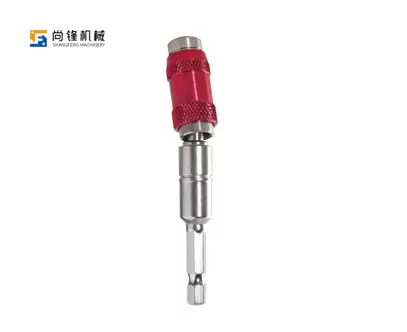
Quick release mechanisms are widely used in cordless drills, impact drivers, ratchet screwdrivers, manual screwdriver systems, and automated fastening equipment. However, not all quick release designs provide the same performance. Differences in locking structure, sleeve geometry, internal magnets, material strength, and manufacturing tolerances can directly affect connection stability and service life.
For industrial and professional applications, selecting the right quick release solution requires evaluating both its mechanical structure and its compatibility with the complete fastening system.
How Does a Quick Release Bit Holder Work?
A quick release bit holder is designed to connect a screwdriver bit to a driving tool while allowing the user to remove and replace the bit without additional tools. Most common designs use a spring-loaded locking mechanism. When a compatible bit is inserted, the retaining structure engages with the bit's shank or retaining groove. Pulling or sliding the release sleeve disengages the locking mechanism, allowing the bit to be removed.
The mechanism typically consists of a holder body, retaining balls or locking elements, a spring, and an external release sleeve. Some designs also incorporate a magnet to help stabilize the bit during insertion and removal. The locking components must work together with controlled clearances. If the spring force is insufficient, the bit may not remain securely locked under vibration. Excessive spring force, on the other hand, can make bit replacement difficult and increase operating effort.
A reliable design should provide a clear locking position, consistent release action, and sufficient retention under the torque and vibration conditions expected in service.
1/4-Inch Hex Shank Compatibility and Dimensional Accuracy
The 1/4-inch hex shank is one of the most widely used interfaces for screwdriver bits and quick change holders. Its standardized geometry supports compatibility across a broad range of fastening tools and accessories. However, nominal compatibility does not eliminate the need for dimensional control.
The internal hexagonal profile must match the bit shank closely enough to limit excessive rotational movement while allowing smooth insertion. Excessive clearance can produce wobble and uneven load distribution, while an overly tight fit may make bit installation difficult. The retaining groove and locking components must also be correctly positioned to ensure reliable engagement.
For manufacturers supplying international markets, dimensional specifications should be aligned with the applicable product standards and the intended tool interface. A holder designed for standard 1/4-inch hex bits should be verified using appropriate gauges and representative bits rather than relying solely on nominal dimensions.
Torque Transmission and Mechanical Durability
During fastening, torque travels from the driver through the holder and into the screwdriver bit. The hexagonal interface transfers rotational force, while the locking mechanism primarily prevents axial movement. These functions should be considered separately during product design and testing.
For example, a holder used with a manual ratchet screwdriver may experience different loading conditions from one installed on a high-torque impact driver. Impact tools generate repeated torque pulses and vibration, which can accelerate wear in the internal locking components. A holder that performs well under light manual operation may not provide sufficient durability for demanding powered applications.
Material selection is therefore important. Alloy steel is commonly used for load-bearing tool accessories because of its strength and heat-treatment potential. The appropriate steel grade and hardness depend on the holder's geometry, required torque capacity, and manufacturing process. Excessive hardness may increase brittleness, while insufficient hardness can lead to deformation or wear around the hexagonal interface.
Heat treatment should be controlled to achieve the required balance between strength, toughness, and wear resistance. Critical areas such as the drive interface and retaining groove deserve particular attention because local deformation can affect both bit fit and locking performance.
Magnetic Retention vs. Mechanical Locking
Magnetic quick release bit holders and mechanical locking holders serve related but different functions. A magnet helps keep the bit aligned and reduces the likelihood of it falling out during handling. It is particularly useful when changing bits frequently or working in positions where retrieving a dropped bit is inconvenient.
However, magnetic attraction alone should not be treated as a substitute for mechanical locking in applications requiring secure axial retention. A mechanical locking structure provides positive engagement with the bit's retaining groove, while the magnet mainly assists positioning and handling.
For professional applications, combining magnetic assistance with a mechanical retention mechanism can offer a practical balance between convenience and security. The specific configuration should be selected according to the tool type, bit geometry, and operating environment.
Manufacturing Quality: Why Precision Matters
The performance of a quick release bit holder depends heavily on manufacturing consistency. Even small dimensional variations in the internal bore, locking groove, sleeve, or spring seat can affect the release action and retention force.
Cold forming and precision machining are commonly used in the production of screwdriver accessories. Cold forging can improve material utilization and provide consistent component geometry when the process is properly controlled. Subsequent machining, heat treatment, and surface finishing establish the dimensional and mechanical properties required for reliable operation.
Quality inspection should cover more than external appearance. Relevant checks include hexagonal interface dimensions, concentricity, sleeve movement, spring performance, locking engagement, and surface defects. Functional testing should verify that the bit can be inserted, locked, released, and reinserted repeatedly without abnormal resistance or loss of retention.
For impact-rated applications, additional durability testing under representative torque and vibration conditions is advisable. Test conditions should reflect the intended tool and application rather than relying on a single universal torque figure.
Choosing the Right Quick Release Bit Holder
The best quick release bit holder depends on the fastening environment. For general workshop use, ease of bit replacement and compatibility with standard 1/4-inch hex bits may be the main considerations. For construction, automotive maintenance, and industrial assembly, retention reliability, impact resistance, and wear performance become more important.
Before selecting a product, it is useful to confirm the shank interface, overall length, locking mechanism, magnetic configuration, material specification, and intended driver type. Product testing should also evaluate bit wobble, insertion and release effort, and retention after repeated operating cycles.
Shangfeng Machinery Co., Ltd. specializes in screwdriver bits, ratchet screwdrivers, nut setters, bit holders, quick-change devices, and screwdriver bit sets. The company uses automated tool manufacturing equipment and high-precision inspection equipment, together with Taiwan cold forging technology, to manufacture screwdriver bits and related accessories according to DIN and ANSI standards. Its BSCI certification also supports its commitment to responsible manufacturing practices.
Building a More Reliable Fastening System
A quick release bit holder is a relatively small component, but its performance can influence the efficiency and reliability of an entire fastening operation. Accurate hexagonal geometry, consistent locking engagement, suitable material properties, and controlled heat treatment all contribute to dependable operation.
For professional tool applications, the most suitable holder is not simply the one that allows the fastest bit change. It is the one that maintains secure retention, transfers torque reliably, and delivers consistent performance over repeated use. Evaluating these characteristics together helps manufacturers and tool brands select accessories that support long-term fastening quality.