
 EN


The performance of a nut setter depends on much more than its nominal socket size or external appearance. In repetitive fastening operations, the working socket must withstand repeated rotational loads, maintain accurate engagement with hexagonal fasteners, and resist deformation under demanding operating conditions. For companies evaluating nut setter China manufacturers, understanding how these tools are produced is essential to assessing long-term durability, dimensional consistency, and production reliability.
A nut setter may appear to be a relatively simple steel component, but its manufacturing involves several closely connected processes, including material preparation, cold forging, heat treatment, precision finishing, and dimensional inspection. Small variations in any of these stages can influence socket engagement, torque transmission, wear resistance, and service life.
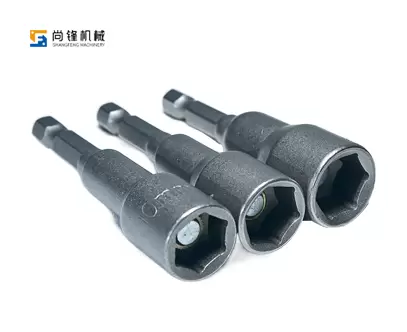
Why Cold Forging Is Important in Nut Setter Manufacturing
Cold forging is a forming process in which metal is shaped under high pressure without heating the material to its hot-working temperature. It is widely used in the production of screwdriver bits and other precision fastening accessories because it supports repeatable geometry and efficient material utilization.
During cold forging, a prepared steel blank is compressed into a specified shape using precision dies. The forming process can produce consistent shank geometry and working-end configurations while reducing the amount of material removed during subsequent machining.
One important advantage is production repeatability. Once the forming equipment and tooling are properly configured, manufacturers can produce large quantities of components with relatively consistent dimensions. This is particularly important for standardized fastening accessories, where even small dimensional differences may affect compatibility with power tools or fasteners.
Cold forging also causes plastic deformation that can influence the material's grain structure and mechanical characteristics. However, the actual improvement in strength and fatigue performance depends on the steel grade, deformation conditions, forming direction, and subsequent heat treatment. Cold forging should therefore be considered part of an integrated manufacturing process rather than an automatic guarantee of higher durability.
For nut setter manufacturers, die precision, blank dimensions, lubrication, forming pressure, and production stability all require controlled management.
Material Selection: Balancing Hardness and Toughness
Nut setters operate under repeated mechanical loads. Their working sockets must resist wear and deformation, while their shanks must transmit rotational force without premature failure.
S2 tool steel is commonly used in screwdriver bits and fastening accessories because it offers a useful combination of hardness, toughness, and wear resistance when properly processed. Other alloy steels may also be suitable depending on the intended application and product design.
Material selection should be based on the expected operating conditions. Standard fastening operations may require different mechanical characteristics from applications involving high-frequency impact drivers or repetitive industrial assembly.
Hardness is an important indicator, but it should never be evaluated in isolation. Excessive hardness can increase brittleness, especially in components with sharp transitions or insufficient cross-sectional support. Conversely, insufficient hardness may result in socket deformation and faster wear.
A reliable manufacturing specification should define the material grade, heat treatment requirements, hardness range, and relevant mechanical performance criteria. Material certificates and batch traceability provide additional assurance when consistent production quality is required.
Heat Treatment: Controlling the Final Mechanical Properties
After forming, heat treatment helps establish the required hardness and mechanical characteristics of the nut setter. The process typically involves controlled heating and cooling, with specific parameters determined by the selected steel grade and product geometry.
The main objective is to achieve a suitable balance between hardness and toughness. The socket needs sufficient resistance to deformation during fastening, while the connecting shank must withstand torsional loading.
Inconsistent heat treatment can produce significant quality variations. Excessive hardness may increase the risk of brittle fracture, while inadequate hardening may cause premature wear or socket rounding. Temperature uniformity, holding time, cooling conditions, and subsequent tempering must therefore be controlled.
Hardness testing should be performed at appropriate locations using a defined test method. For more demanding applications, manufacturers may also evaluate torsional strength, impact resistance, and durability under repeated fastening cycles.
The testing method should reflect the actual product design. A result obtained from one section of the tool cannot automatically represent the mechanical behavior of every working area.
Precision Geometry and Dimensional Inspection
A nut setter must fit the fastener accurately to transmit torque efficiently. The most important dimensional feature is the socket's across-flats measurement, which determines compatibility with the external hexagonal fastener.
Socket depth is another critical parameter. If the socket is too shallow, the fastener may not engage sufficiently. If its internal geometry is inconsistent, contact may become concentrated on a limited area, increasing wear and the risk of slipping.
The shank also requires precise dimensional control. A 1/4-inch hex shank, for example, is widely used for quick-change power tool accessories. Its dimensions and retention features must be compatible with the intended bit holder or driver.
Typical inspection items include:
Inspection Item | Technical Purpose | Potential Quality Risk |
|---|---|---|
Socket across-flats | Ensures fastener compatibility | Slipping and fastener damage |
Socket depth | Ensures adequate engagement | Incomplete fastening |
Shank dimensions | Ensures tool compatibility | Poor retention or loose fitting |
Concentricity | Maintains alignment during rotation | Vibration and uneven loading |
Surface finish | Reduces defects and improves contact quality | Premature wear |
Hardness | Verifies heat treatment consistency | Deformation or brittleness |
Overall length | Confirms installation accessibility | Application mismatch |
High-precision inspection equipment helps manufacturers identify dimensional deviations before products are released. For large production batches, inspection frequency and sampling procedures should be defined according to product criticality and quality requirements.
DIN and ANSI Standards in Nut Setter Production
International standards provide a useful reference for dimensional compatibility, product requirements, and manufacturing quality. DIN and ANSI standards are particularly relevant to fastening tools and accessories used in different markets.
However, manufacturers should distinguish between compliance with a specific standard and general claims of manufacturing according to DIN or ANSI requirements. Not every nut setter specification is covered by the same standard, and different product categories may have different applicable requirements.
For customers sourcing from a nut setter China supplier, it is important to confirm the exact standard, product specification, dimensional tolerances, and inspection criteria associated with each item. Metric and imperial specifications should also be clearly identified to avoid mismatches in international distribution.
What to Evaluate When Choosing a Nut Setter China Manufacturer
A reliable supplier should demonstrate control over the complete manufacturing process rather than depending entirely on outsourced production and final visual inspection.
Shangfeng Machinery Co., Ltd. specializes in screwdriver bits, ratchet screwdrivers, nut setters, bit holders, quick-change devices, and screwdriver bit sets. Its manufacturing capabilities include automated tool production equipment, high-precision inspection equipment, and Taiwan cold forging technology.
The company manufactures screwdriver bits and related accessories according to DIN and ANSI standards where applicable, serving customers in international markets. Its BSCI certification also provides evidence of its commitment to responsible manufacturing practices.
For customers developing a long-term supply relationship, the most relevant evaluation criteria include material traceability, cold forging consistency, heat treatment control, dimensional inspection, production capacity, and batch-to-batch stability. Sample testing should cover the actual socket sizes, shank configurations, and operating conditions required by the intended application.
Improving Fastening Reliability Through Manufacturing Consistency
The service life of a nut setter is determined by the combined performance of its material, geometry, forming process, heat treatment, and inspection system. A high-quality steel grade cannot compensate for inaccurate socket dimensions, just as precision machining cannot fully overcome inappropriate heat treatment.
Manufacturers that integrate automated production with controlled forming and high-precision inspection are better positioned to maintain consistent product specifications across large production runs. This is particularly important for distributors and industrial users managing multiple tool sizes and recurring replenishment orders.
For demanding fastening applications, qualification should include dimensional verification, hardness testing, and representative fastening trials. Where impact drivers are involved, testing should reproduce the actual fastener type, torque conditions, and duty cycle as closely as possible.
Conclusion
Cold forging, material selection, heat treatment, and precision inspection are fundamental to producing durable nut setters. Each process contributes to the tool's ability to maintain accurate fastener engagement and withstand repeated mechanical loading.
When evaluating nut setter China manufacturers, companies should look beyond product appearance and compare the supplier's actual manufacturing processes, quality control capabilities, applicable standards, and production consistency. Shangfeng Machinery Co., Ltd. combines Taiwan cold forging technology, automated manufacturing equipment, and high-precision inspection systems to produce nut setters and a wider range of professional fastening accessories for global markets.