
 EN


In automotive repair, machinery maintenance, equipment assembly, and industrial fastening, operators frequently switch between screwdriver bits, sockets, and different driving tools. Each tool change takes time, and an unsuitable connection can introduce excessive movement, poor torque transfer, or accidental disengagement. A quick release socket adapter helps simplify these transitions by providing a convenient connection between a compatible drive tool and socket accessory.
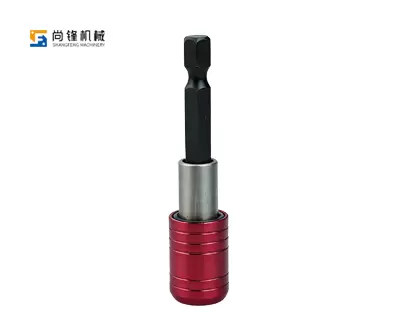
However, quick release convenience should never come at the expense of mechanical reliability. The adapter must maintain a secure connection under rotational loads, vibration, and repeated installation cycles. Its drive interface, locking mechanism, material strength, and dimensional accuracy all determine whether it can perform reliably in the intended application.
Understanding these factors is essential when selecting socket adapters for professional tool systems.
What Is a Quick Release Socket Adapter?
A quick release socket adapter is a tool accessory that connects a driving tool to a socket or another compatible attachment while allowing rapid removal and replacement. Depending on the design, it may convert between different drive interfaces or provide a locking mechanism for accessories with a compatible connection.
Common configurations include adapters with a 1/4-inch hex shank for cordless drills and impact drivers, as well as adapters designed to connect different square-drive sizes. The exact structure varies according to the intended application.
A typical quick release design incorporates a drive body, retaining mechanism, spring-loaded locking element, and release sleeve or collar. The locking component engages with the corresponding groove or retaining feature on the socket or attachment. When the release mechanism is operated, the locking element retracts to allow removal.
The design must balance two requirements: sufficient retention during operation and convenient release when the accessory needs to be changed.
Understanding Drive Sizes and Compatibility
Compatibility is the first specification to confirm when selecting a quick release socket adapter. Common square-drive sizes include 1/4 inch, 3/8 inch, and 1/2 inch. These interfaces are used across different tool categories and fastening requirements.
A 1/4-inch drive is frequently found in compact hand tools and lightweight fastening applications. A 3/8-inch drive is widely used for general automotive maintenance and mechanical assembly. A 1/2-inch drive is more commonly associated with larger fasteners and applications requiring higher torque capacity.
These are typical application patterns, not fixed torque ratings. The actual capacity depends on the adapter's material, geometry, manufacturing quality, and the limitations of the connected tool and socket.
Hex shank adapters also require attention to the shank standard. A 1/4-inch hex shank is widely used in screwdriver and drill accessories, but the retaining groove configuration must match the receiving holder. An adapter may have the correct nominal size and still be unsuitable if its locking geometry differs from the intended interface.
Before ordering, the complete connection should be checked: driver interface, adapter input, adapter output, socket retention structure, and operating tool type. This prevents compatibility problems that may only become apparent after the accessory is installed.
Torque Transmission and Impact Resistance
A socket adapter transfers torque from the driving tool to the attached socket. Under operation, the adapter experiences torsional stress, and the stress distribution depends on the cross-sectional geometry, material properties, and contact conditions at each interface.
Impact drivers and impact wrenches introduce additional challenges. Their repeated torque pulses create dynamic loading that can accelerate fatigue, deformation, and wear. Standard adapters intended for general rotational use should not automatically be assumed suitable for impact applications.
Impact-rated adapters generally require appropriate material selection, heat treatment, and structural design. The transition between the drive section and the adapter body is particularly important because abrupt changes in cross-section can create stress concentrations. Poorly controlled machining marks or sharp geometric transitions may also contribute to fatigue failure.
A suitable adapter should be selected according to the maximum expected operating conditions and the tool manufacturer's compatibility recommendations. Where impact use is intended, the product should be specifically designed and tested for that purpose.
Material Selection and Heat Treatment
Alloy steel is commonly used for professional socket adapters because it can provide a combination of strength, toughness, and wear resistance. The exact material grade should be selected according to the adapter's size, geometry, intended torque range, and manufacturing route.
Heat treatment is equally important. If hardness is too low, the drive interface may deform under repeated loading. If the component is excessively hard without sufficient toughness, it may become more susceptible to fracture under impact loading. A suitable heat-treatment process should establish the mechanical properties required by the application rather than maximizing hardness alone.
Surface finishing can also affect performance. Corrosion protection may be important for tools used in workshops, outdoor maintenance, or humid industrial environments. Coating selection should account for dimensional requirements, wear resistance, and the possibility of coating damage during repeated insertion.
Quick Release Locking Mechanism: Retention vs. Convenience
The locking mechanism is a defining feature of a quick release adapter. Its purpose is to prevent the connected socket or attachment from slipping off during use while allowing controlled removal.
Spring force, locking-element geometry, groove dimensions, and sleeve travel all influence the mechanism's behavior. If the locking element does not engage fully, the accessory may become loose under vibration. If the release sleeve is poorly designed, operators may experience inconsistent release force or accidental disengagement.
A reliable design should provide clear engagement feedback and maintain retention after repeated connection cycles. The locking mechanism should also be protected against excessive contamination where possible, especially in workshops or industrial environments where dust, metal particles, and grease are common.
It is important to distinguish between quick release adapters and impact-rated adapters with locking features. Not every quick release mechanism is intended for high-impact loading. The product specification should clearly identify compatible tools and operating conditions.
Manufacturing Precision and Quality Inspection
Manufacturing consistency has a direct influence on adapter performance. Dimensional deviations at the drive interface can produce excessive clearance, uneven contact, or difficulty installing the accessory. Poor concentricity may cause vibration during rotation, while inaccurate locking grooves can compromise retention.
Shangfeng Machinery Co., Ltd. uses automated tool manufacturing equipment and high-precision inspection equipment to produce screwdriver bits and related accessories. Its manufacturing capabilities include Taiwan cold forging technology, with products manufactured according to DIN and ANSI standards where applicable.
For quick release socket adapters, quality control should include dimensional verification of drive interfaces, inspection of locking components, hardness testing, and functional checks. Depending on the intended application, torque testing and repeated insertion-release testing can provide further evidence of performance consistency.
A robust inspection process should verify both individual component dimensions and the assembled adapter's operation. This is important because a spring, locking ball, sleeve, and adapter body may each meet their individual dimensions while still producing inconsistent performance when assembled.
Applications Across Professional Tool Systems
Quick release socket adapters are used in automotive maintenance, machinery servicing, construction, equipment installation, and general workshop operations. In automotive repair, they can reduce accessory changeover time when moving between compatible driving tools and sockets. In industrial assembly, they help simplify tool configurations and support more flexible fastening operations.
For maintenance teams working with different fastener sizes, quick accessory changes can reduce interruptions and make tool management more efficient. However, the adapter must be matched to the expected torque, working space, and accessibility requirements. Compact adapters may be useful in confined areas, while longer configurations may improve access to recessed fasteners but can also increase bending loads.
The operating environment should therefore guide product selection. Oil, dust, vibration, frequent accessory changes, and high torque demand can all influence the required design.
How to Select a Reliable Quick Release Socket Adapter
A suitable selection process starts with confirming the input and output drive sizes, the connected tool type, and whether the application involves standard rotation or impact operation. Material grade, heat treatment, locking structure, overall length, corrosion protection, and dimensional tolerances should then be evaluated against the working conditions.
For large-volume procurement, sample testing is valuable. Representative adapters should be checked for fit with actual tools and sockets, locking consistency, release effort, rotational stability, and durability under the intended operating conditions. Clear technical specifications help maintain consistency between sample approval and subsequent production batches.
A Reliable Connection for Efficient Tool Operation
A quick release socket adapter is more than a simple size-conversion accessory. It is a load-transmitting component that must maintain accurate engagement and stable performance throughout repeated use. Drive compatibility, torque capacity, material toughness, heat treatment, and locking reliability all influence its service life.
With its product range covering screwdriver bits, ratchet screwdrivers, nut setters, bit holders, quick-change devices, and screwdriver bit sets, Shangfeng Machinery Co., Ltd. provides related tool accessories for international markets. By combining cold forging technology, automated production equipment, and precision inspection, the company focuses on manufacturing consistency and dependable tool connections.
Choosing the right quick release socket adapter means matching its mechanical design to the actual tool system and operating conditions. This helps reduce connection problems, improve accessory changeover efficiency, and support more reliable fastening operations.