
 EN
EN


Power tool adaptors operate at the connection point between a power tool and its working accessory. Although compact in size, they must transmit rotational force while resisting vibration, impact, wear, and repeated mechanical loading. In high-torque applications, the quality of the adaptor can directly influence tool efficiency, accessory retention, and overall fastening reliability.
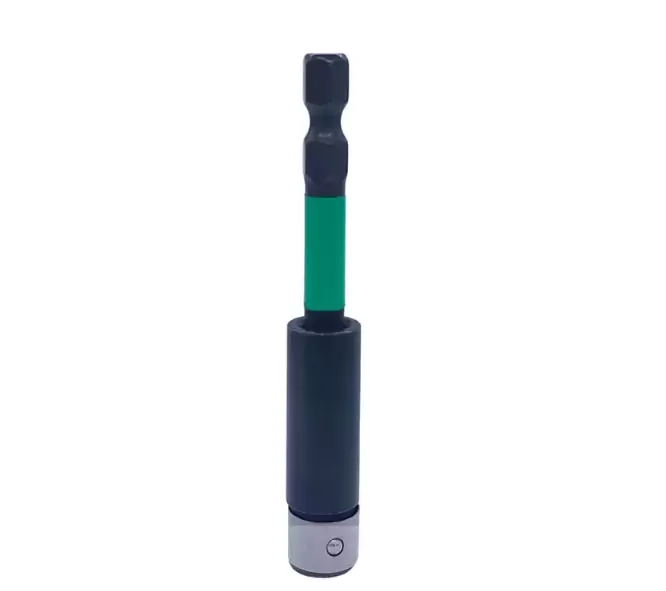
For manufacturers and distributors sourcing from a power tool adaptor supplier, the most important question is not simply whether an adaptor fits. The real requirement is whether the adaptor can maintain secure engagement and dimensional stability throughout repeated use.
This makes material, geometry, heat treatment, manufacturing technology, and inspection accuracy critical factors in supplier evaluation.
High-Torque Applications Require More Than Hardness
Power tool adaptors used with impact drivers and high-torque cordless tools can experience repeated shock loading. Every impact cycle generates a rapid change in torque, creating stress concentrations around the drive interface and locking features.
A common mistake is to assume that higher hardness automatically means better performance. In reality, an adaptor requires a balanced combination of hardness and toughness.
Hardness contributes to wear resistance and resistance to deformation. Toughness helps the component absorb impact without cracking. If the material is excessively hard but insufficiently tough, repeated impact can increase the risk of brittle failure.
A qualified power tool adaptor supplier should therefore control both material selection and heat-treatment parameters according to the intended application.
Cold Forging Improves Production Efficiency and Geometry
Manufacturing technology has a significant influence on adaptor quality.
Cold forging forms the metal under controlled pressure rather than producing the complete component through extensive material removal. For high-volume tool-accessory production, this process can provide efficient material utilization and consistent geometry.
Shangfeng Machinery uses Taiwan cold forging technology in the production of screwdriver bits and related accessories. The process is particularly suitable for components requiring repeatable dimensions across large production batches.
After forming, additional machining or finishing operations may be used where necessary to achieve the required interface geometry.
The benefit is not simply faster production. Stable forming can help establish a repeatable dimensional foundation for subsequent inspection and finishing.
Drive Interface Geometry Controls Torque Transfer
The connection between the adaptor and the power tool must transmit torque without excessive clearance.
Consider a hexagonal interface. If the mating dimensions are too loose, the adaptor can move slightly under load. This movement can contribute to wear at the contact surfaces and may increase vibration during rotation.
If the dimensions are excessively tight, accessory installation can become difficult and quick-change functionality may be compromised.
The correct balance depends on the applicable standard and intended connection system. DIN and ANSI standards can provide important references for dimensional requirements and interchangeability.
Shangfeng Machinery produces screwdriver bits and related accessories according to DIN and ANSI standards, supporting applications that require standardized international specifications.
Concentricity Matters at High Rotational Speed
An adaptor can have the correct overall dimensions and still perform poorly if concentricity is inadequate.
When the driving and driven components are not sufficiently aligned, eccentric rotation can create additional vibration. At higher rotational speeds, even a small deviation can become more noticeable.
This is particularly relevant for applications involving long accessories or precision fastening. Excessive runout can affect screw alignment and may increase mechanical wear.
Precision inspection equipment can be used to control critical geometric characteristics and reduce the variation between production batches.
For high-volume orders, the supplier should define inspection methods and acceptance criteria before mass production begins.
Retention Mechanisms Must Balance Security and Usability
Quick-change systems and socket adaptors often require a retention mechanism that holds the accessory securely while allowing intentional removal.
The mechanism must withstand vibration and rotational forces without accidental release. At the same time, excessive retention force can make accessory replacement inconvenient.
The correct design depends on the application, drive size, accessory geometry, and expected operating conditions.
Functional testing should therefore simulate actual installation and removal cycles rather than evaluating the retention component only through dimensional inspection.
Surface Treatment Protects the Working Component
Power tool accessories are frequently exposed to workshop dust, humidity, oils, and repeated handling. Surface treatment can provide additional protection against corrosion and surface wear.
However, coating or finishing quality should not be evaluated independently from dimensional requirements. If a surface treatment significantly changes a critical interface dimension, the finished adaptor may no longer achieve the required fit.
A well-controlled production process therefore considers forming, machining, heat treatment, surface finishing, and final dimensional inspection as connected operations.
Automated Production Requires Consistent Components
A power tool adaptor may perform adequately in manual assembly even when small dimensional variations exist. Automated production is less tolerant of such variation.
When adaptors are fed, assembled, or tested automatically, differences in geometry can affect positioning, insertion, retention, and machine-cycle stability.
This makes manufacturing consistency particularly important for large-volume orders.
Shangfeng Machinery has invested in automated tool-production equipment and high-precision inspection equipment. This combination supports the repeatability required for industrial-scale manufacturing rather than relying entirely on manual processing and inspection.
Supplier Capability Should Include More Than the Adaptor
Many customers purchasing power tool adaptors also require complementary fastening accessories.
A supplier capable of manufacturing screwdriver bits, nut sockets, bit holders, quick-change devices, ratchet screwdrivers, and bit sets can simplify product development and sourcing.
For example, an adaptor and socket system should be evaluated as a compatible combination. Similarly, a bit holder and screwdriver bit should maintain appropriate dimensional and retention compatibility.
Shangfeng Machinery's broader product portfolio allows these related components to be developed within the same manufacturing environment.
This can reduce the complexity of managing specifications across multiple suppliers.
Testing Should Reflect the Actual Power Tool
A meaningful product evaluation should use the power tool and accessory combination intended for production.
Testing can examine fit, runout, torque transmission, retention, impact resistance, wear, and repeated installation cycles.
For high-torque applications, repeated impact testing is especially important because a component may pass a static torque test but show accelerated wear or failure after repeated shock loading.
The acceptance criteria should therefore reflect the real operating environment rather than relying exclusively on catalog specifications.
Supply Reliability Is Part of Product Quality
For global tool-accessory programs, quality consistency must be maintained from the first shipment to subsequent production batches.
Stable raw-material sourcing, controlled forming processes, inspection records, standardized packaging, and production traceability all contribute to reliable supply.
BSCI certification can also support international customers that require documented social-compliance practices.
Shangfeng Machinery serves international markets and combines standardized production with automated equipment, precision inspection, and a broad range of tool accessories.
Conclusion
A power tool adaptor supplier for high-torque applications needs to demonstrate much more than the ability to produce a component that fits.
The adaptor must maintain accurate interface geometry, adequate concentricity, appropriate hardness and toughness, reliable retention, and stable performance under repeated torque and impact. Manufacturing consistency is equally important when the component is used in high-volume assembly or automated production.
Shangfeng Machinery combines Taiwan cold forging technology, automated manufacturing equipment, high-precision inspection, and DIN and ANSI-based production for tool accessories. With products covering screwdriver bits, ratchet screwdrivers, nut sockets, bit holders, quick-change devices, and screwdriver bit sets, the company can support broader fastening-tool requirements while maintaining a consistent manufacturing approach.
For demanding power tool applications, evaluating the supplier's complete manufacturing and quality-control capability is ultimately more valuable than comparing adaptor prices alone.