
 EN
EN


Choosing the right screwdriver bits for woodworking directly affects fastening quality, tool life, and production efficiency. Wood screws are installed under different conditions from machine screws: the material is relatively soft and variable, screw heads may be recessed, and applications often involve high-speed cordless or impact drivers. A bit that performs well on one wood species or screw type may show premature wear, cam-out, or poor engagement in another application.
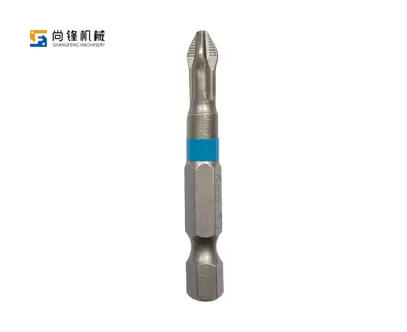
For furniture assembly, cabinetry, wooden structures, decking, and workshop production, the selection should therefore consider bit geometry, material, hardness, drive profile, torque resistance, and compatibility with the fastening tool rather than focusing only on price or appearance.
Match the Bit Profile to the Screw
The first requirement is accurate engagement between the bit and screw recess. Common woodworking screws use Phillips, Pozidriv, Torx, and other drive profiles, with Torx increasingly preferred for applications requiring higher torque transmission and reduced cam-out.
For example, a Torx T20 or T25 bit can provide a larger contact area with the corresponding screw recess than a conventional Phillips configuration. This helps transfer driving torque while reducing the tendency of the bit to climb out of the screw head. However, the size must match the screw precisely. Using a T20 bit in a T25 recess or a worn bit in a correctly sized recess can quickly increase mechanical stress and damage both components.
For woodworking applications involving thousands of repetitive fastening cycles, dimensional consistency is particularly important because even small deviations in the drive geometry can accumulate into higher rejection rates and premature bit replacement.
Cold Forging Supports Consistent Geometry
The manufacturing process has a direct influence on screwdriver bit performance. Shangfeng Machinery uses Taiwan cold forging technology to form screwdriver bits, helping achieve consistent dimensional geometry before subsequent processing.
Cold forging forms the metal under controlled pressure rather than removing most of the material through machining. This can improve production consistency and maintain the designed shape of the drive profile. For a screwdriver bit, accurate tip geometry is critical because the contact between the bit and screw head determines how effectively torque is transmitted.
After forming, heat treatment and precision inspection become equally important. A woodworking bit needs sufficient hardness at the working end to resist wear, but excessive hardness without adequate toughness can increase the risk of fracture under impact loading.
Hardness and Toughness Must Be Balanced
Woodworking applications do not all generate the same load profile. Installing screws into soft pine may require relatively low torque, while driving structural screws into hardwood, laminated timber, or dense engineered wood can generate substantially higher resistance.
A bit designed for high-speed impact driving needs to withstand repeated torsional and impact loads. Excessive hardness can improve wear resistance but may reduce toughness. Insufficient hardness, on the other hand, can accelerate tip deformation and rounding.
The appropriate heat-treatment condition therefore depends on the intended application. A production-grade screwdriver bit should maintain its drive profile after repeated fastening cycles rather than simply showing high initial hardness.
Length and Holder Compatibility Affect Control
Bit length is another practical consideration. Short 25 mm bits are widely used with magnetic bit holders and compact cordless screwdrivers, while longer 50 mm, 65 mm, 90 mm, or 150 mm configurations may be useful when access depth or recessed fastening positions requires additional reach.
Longer bits provide access but can also introduce more bending and torsional deflection under load. For repetitive woodworking assembly, the selected length should be sufficient for access without creating unnecessary leverage.
The shank interface must also match the holder or quick-change system. Standard 1/4-inch hex shanks are common in power-tool applications, but dimensional accuracy at the shank is essential for secure retention and reliable torque transmission.
Impact Drivers Require a Different Performance Standard
A major mistake is assuming that any hardened screwdriver bit can be used with an impact driver. Impact tools generate repeated torque pulses that place different stresses on the bit compared with conventional rotary screwdrivers.
For impact applications, the bit must tolerate rapid torsional loading without cracking around the transition between the drive tip and shank. Geometry, material selection, heat treatment, and overall structural design all contribute to service life.
In woodworking factories, where a fastening station may operate continuously for several hours, impact-rated bits can reduce unexpected breakage and tool-change frequency. The correct solution should be validated under the actual driver torque, screw dimensions, substrate, and fastening depth rather than selected solely from a catalog description.
Standards Help Control Dimensional Consistency
For industrial sourcing, standards provide an important baseline for evaluating screwdriver bits. Shangfeng Machinery produces screwdriver bits and related accessories according to DIN and ANSI standards, supporting consistent dimensions across product batches.
Standards do not automatically guarantee that a bit is suitable for every woodworking application, but they establish recognized dimensional and performance requirements for the relevant tool category. When large quantities are required, consistency between batches is particularly important because interchangeable bits should maintain predictable engagement with the same screw specifications.
Shangfeng Machinery combines automated tool-production equipment with high-precision inspection equipment and has obtained BSCI certification, supporting its manufacturing and quality-management capabilities for global customers.
Select Bits According to the Complete Fastening Process
The right screwdriver bits for woodworking should be evaluated as part of the complete fastening system: screw type, wood or panel material, driver type, operating torque, fastening depth, cycle frequency, and required service life all matter.
For cabinet production, a compact Phillips or Pozidriv bit may be appropriate for controlled assembly, while structural timber and decking applications may benefit from Torx geometry and impact-rated construction. In high-volume furniture manufacturing, consistent dimensions and repeatable wear performance can be more important than selecting the lowest unit-cost bit.
A technically suitable bit should maintain secure screw engagement, resist tip deformation, tolerate the required torque, and remain compatible with the existing holder and driver system. This approach turns screwdriver bit selection from a simple accessory purchase into a controlled component decision that directly supports woodworking productivity and fastening quality.