
 EN
EN


In woodworking production, screwdriver bits are small components with a direct effect on fastening consistency. A bit that wears quickly can cause cam-out, damaged screw heads, inconsistent insertion depth, and frequent tool changes. These problems become particularly costly when hundreds or thousands of screws are installed every shift.
The performance of screwdriver bits for woodworking depends on the interaction between bit geometry, steel properties, heat treatment, manufacturing accuracy, and the operating conditions of the power tool. Understanding these factors makes it easier to select a bit for furniture assembly, cabinetry, wooden construction, decking, and other repetitive fastening applications.
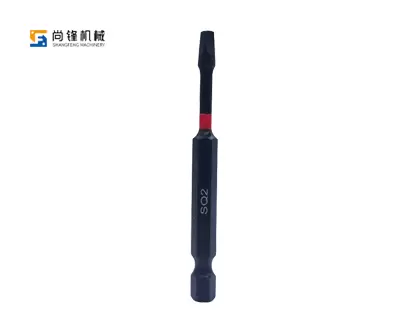
Why Bit Geometry Matters
A screwdriver bit transfers torque through a relatively small contact area, so the geometry of the tip must closely match the screw recess. Poor dimensional accuracy can create localized stress concentrations, allowing the tip to slip or deform under load.
Torx profiles are widely used in woodworking because their star-shaped geometry provides multiple contact surfaces and can transfer relatively high torque with reduced cam-out compared with conventional cross-head designs. Phillips and Pozidriv remain common in furniture, cabinetry, and general-purpose woodworking, particularly where the screw system is already standardized.
The correct profile and size should always be treated as a matched pair. Even a high-quality bit can perform poorly if the drive size does not correspond precisely to the screw head.
Material Selection Determines Service Life
A screwdriver bit must combine hardness with toughness. The working tip needs enough hardness to resist wear and maintain its geometry, while the shank must withstand torsional loading without premature fracture.
This balance becomes more important when the bit is used with a cordless impact driver. Unlike a conventional screwdriver, an impact driver applies repeated torque pulses, creating cyclic mechanical stress. A material and heat-treatment combination optimized only for surface hardness may therefore fail earlier than a tougher design specifically developed for impact conditions.
For high-frequency woodworking operations, service life should be evaluated by the number of consistent fastening cycles rather than by whether a new bit performs well during the first few screws.
Cold Forging Improves Manufacturing Consistency
Shangfeng Machinery uses Taiwan cold forging technology for screwdriver bit production. This process is well suited to forming high-volume metal components with controlled dimensions and repeatable geometry.
For a bit, manufacturing consistency is especially important at the tip and shank interface. Variations in the drive profile can alter contact with the screw, while dimensional deviations in the hex shank can affect retention inside a holder or quick-change chuck.
Automated production equipment combined with high-precision inspection can help control these variables across production batches. For customers purchasing large quantities or using standardized fastening systems, batch-to-batch consistency is a practical performance requirement rather than simply a quality-control advantage.
Choose the Right Bit for the Driver
The driver determines the mechanical load placed on the bit. A standard cordless drill or electric screwdriver generally applies smoother rotary torque, while an impact driver introduces repeated high-energy pulses.
If the application uses an impact driver, an impact-compatible bit should be selected according to the manufacturer's specifications. The required bit length should also be considered. A 25 mm bit is compact and suitable for many holder-based applications, whereas 50 mm, 65 mm, 90 mm, or longer bits may be necessary for recessed screws or difficult-to-access areas.
Longer does not mean stronger. As the free length increases, bending and torsional effects can become more significant. The shortest length that provides adequate access is often preferable for repetitive fastening.
Consider the Wood and Screw Combination
Woodworking materials can vary considerably in density. Softwoods such as pine generally require less driving torque than hardwoods such as oak or maple. Engineered materials, laminated panels, plywood, and dense composite boards introduce additional variations in screw resistance.
Fastener diameter and length also affect the load. A small furniture screw installed into a pre-drilled panel places a very different demand on the bit from a long structural screw driven directly into hardwood.
For this reason, bit selection should be validated against the actual screw and substrate combination. A bit that performs well in a softwood assembly test may show faster wear when transferred to hardwood or structural applications.
DIN and ANSI Standards Provide a Reliable Baseline
For global sourcing, compliance with recognized dimensional standards helps simplify product selection and replacement. Shangfeng Machinery produces screwdriver bits and related accessories according to DIN and ANSI standards, covering common industrial requirements for tool dimensions and interfaces.
The benefit is particularly relevant when different production lines or facilities need interchangeable tooling. Consistent dimensions reduce compatibility problems and make it easier to standardize bit specifications across multiple applications.
Shangfeng also manufactures ratchet screwdrivers, nut sockets, bit holders, quick-change devices, and screwdriver bit sets, allowing fastening-tool configurations to be matched rather than treating the screwdriver bit as an isolated component.
Reduce Cost Through Total Tool Life
The lowest-priced screwdriver bit is not necessarily the lowest-cost solution. If a low-cost bit needs replacement after 500 fastening cycles while a more durable bit maintains acceptable performance for 2,000 cycles, the actual tooling cost must include replacement frequency, operator intervention, downtime, and damaged fasteners.
For high-volume woodworking, a useful evaluation should therefore compare initial cost, average service life, fastening consistency, replacement time, and compatibility with existing tools.
The best screwdriver bits for woodworking are those that maintain accurate engagement and sufficient mechanical strength throughout the required operating cycle. With controlled cold forging, appropriate heat treatment, precision inspection, and DIN/ANSI-based manufacturing, Shangfeng Machinery provides screwdriver bits and related fastening accessories designed for consistent use across woodworking and other demanding applications.