
 EN


A professional screwdriver bit must do more than fit a screw head. In demanding assembly and fastening operations, it needs to transmit torque efficiently, maintain dimensional accuracy, resist wear, and withstand repeated engagement without premature failure. For manufacturers, tool distributors, and industrial users, selecting the right professional screwdriver bit directly affects fastening consistency, production efficiency, and the overall service life of the tool.
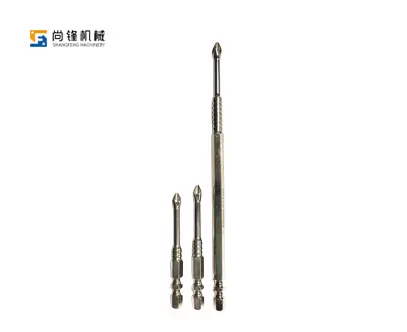
In high-torque applications, bit performance depends on several interacting factors, including material composition, heat treatment, tip geometry, manufacturing accuracy, and compatibility with the driving tool. A bit that performs well during occasional manual fastening may not deliver the same reliability when used with an electric screwdriver, impact driver, or automated assembly system. Understanding these differences is essential when specifying screwdriver bits for professional applications.
Why Torque Capacity Matters in Professional Screwdriver Bits
Torque is one of the primary factors influencing screwdriver bit performance. When a bit engages with a fastener, rotational force is transferred through the tip into the screw recess. If the applied torque exceeds the bit's effective mechanical capacity, deformation, twisting, or tip breakage may occur.
However, selecting a professional screwdriver bit based only on maximum torque ratings can be misleading. Actual performance also depends on the screw type, recess condition, driving speed, material hardness, and fastening depth. For example, a Phillips bit used in repeated sheet-metal assembly experiences different mechanical stresses from a Torx bit used in automotive component fastening.
A high-quality bit should maintain stable engagement throughout the fastening cycle. Poor dimensional accuracy can create excessive clearance between the bit and screw recess, concentrating stress on a smaller contact area. This increases the likelihood of cam-out, recess damage, and premature wear.
For applications involving repeated high-torque fastening, the relationship between tip geometry and fastener recess accuracy is particularly important. A properly manufactured bit distributes contact forces more evenly, helping reduce localized stress and improve fastening consistency.
Material Selection and Heat Treatment Determine Service Life
The material used in a professional screwdriver bit has a direct influence on hardness, toughness, and resistance to mechanical fatigue. Common material options include S2 tool steel and other alloy steels, depending on the intended application and performance requirements.
S2 tool steel is widely used for professional screwdriver bits because it offers a practical balance between hardness and impact resistance. Nevertheless, the material grade alone does not guarantee product quality. Heat treatment must be carefully controlled to achieve the required mechanical properties.
If hardness is too low, the screwdriver bit may experience rapid tip deformation under repeated loading. If hardness is excessively high without sufficient toughness, the bit may become more vulnerable to cracking or brittle fracture, particularly during impact-driven operations.
This is why heat treatment consistency matters as much as raw material selection. Uniform thermal processing helps maintain stable hardness across production batches, reducing performance variations between individual bits.
For industrial applications, buyers should evaluate material specifications alongside hardness testing, dimensional inspection, and actual fastening performance. A professional screwdriver bit intended for continuous production use should demonstrate repeatable performance rather than relying solely on material descriptions.
Tip Geometry and Precision Manufacturing
The tip is the most critical functional area of a screwdriver bit because it directly interfaces with the fastener. Even small dimensional deviations can affect engagement depth, torque transfer, and wear resistance.
Different screw profiles require different tip geometries. Phillips bits are designed for cross-shaped recesses, while Pozidriv bits feature additional contact ribs to improve engagement. Torx bits use a six-lobed profile that provides a larger effective contact area and supports more stable torque transmission in compatible fasteners. Slotted bits, meanwhile, require accurate width and thickness dimensions to minimize slipping.
Manufacturing precision becomes especially important when producing professional screwdriver bits in large quantities. Cold forging is one manufacturing process used to form metal components with controlled geometry and efficient material utilization. Compared with processes that rely heavily on material removal, cold forging can support consistent forming and production efficiency when tooling and process parameters are properly managed.
At Shangfeng Machinery Co., Ltd., Taiwan cold forging technology is applied in screwdriver bit manufacturing. Combined with automated production equipment and precision inspection instruments, this manufacturing approach supports dimensional consistency and repeatable product quality.
For applications requiring interchangeable bits, dimensional control should cover not only the working tip but also the shank. Standardized shank dimensions help ensure compatibility with screwdriver handles, bit holders, ratchet screwdrivers, and quick-change systems.
Matching Bit Types to Different Industrial Applications
Choosing the correct professional screwdriver bit requires consideration of the fastening environment rather than simply selecting the most common profile.
In automotive assembly, Torx and other precision profiles are frequently used because they provide controlled engagement in compact fastening locations. Repeated fastening cycles make tip wear resistance and dimensional stability important.
In electrical equipment manufacturing, Phillips and Pozidriv bits are commonly used for terminal blocks, enclosures, and internal components. Here, precise engagement is important because excessive slipping can damage screw heads or surrounding materials.
For furniture production and general equipment assembly, a combination of Phillips, slotted, and Torx bits may be required. Different screw sizes and fastening depths make a versatile bit selection particularly useful.
Maintenance and repair operations also benefit from professional screwdriver bit sets. Technicians often encounter different fastener standards within the same working environment, making compatibility and quick bit replacement important operational considerations.
The best specification therefore depends on the fastener profile, required torque, driving equipment, working frequency, and expected service life.
Quality Inspection: What Should Be Evaluated Before Bulk Orders?
For distributors and industrial buyers, consistent quality across batches is often more important than the performance of a single sample. A professional screwdriver bit should undergo a structured inspection process covering critical dimensions, material properties, and functional performance.
Dimensional inspection verifies tip geometry, shank size, overall length, and manufacturing tolerances. Hardness testing helps confirm whether the heat treatment process has achieved the intended material characteristics. Torque and durability testing can provide additional information about resistance to deformation and repeated loading.
Production consistency also depends on process control. Automated manufacturing equipment reduces certain forms of manual variation, while precision inspection equipment helps identify dimensional deviations before products enter the finished inventory.
Shangfeng Machinery Co., Ltd. manufactures screwdriver bits, ratchet screwdrivers, nut setters, bit holders, quick-change devices, and screwdriver bit sets. The company uses automated tool production equipment, precision testing equipment, and Taiwan cold forging technology. Its products are manufactured according to applicable DIN and ANSI standards, supporting a range of professional fastening requirements. The company also holds BSCI certification.
For bulk sourcing, it is worth confirming the exact product standard, material specification, hardness range, dimensional tolerance, packaging requirements, and inspection arrangements before production begins.
Building a Reliable Fastening Tool Specification
A professional screwdriver bit should be evaluated as part of a complete fastening system. Its performance depends on the relationship between the bit, fastener, driving equipment, and working conditions. Material quality without accurate geometry is insufficient, just as precise manufacturing cannot compensate for unsuitable material properties.
For high-torque and repeated fastening applications, attention should be given to material toughness, heat treatment consistency, tip accuracy, shank compatibility, and batch inspection. These factors provide a more practical basis for evaluating long-term performance than price or appearance alone.
Shangfeng Machinery Co., Ltd. provides professional screwdriver bit manufacturing supported by cold forging technology, automated production, and precision quality inspection. By combining standardized manufacturing with a broad range of fastening accessories, the company supports customers seeking consistent screwdriver bit solutions for industrial assembly, maintenance, and professional tool applications.