
 EN
EN


ACR bits with anti-slip design are engineered for fastening applications where conventional Phillips-style bits may experience cam-out, inconsistent engagement, or accelerated tip wear. In high-volume assembly, professional maintenance, construction, and power-tool applications, these problems are not simply inconvenient. They can increase fastening time, damage screw heads, reduce bit service life, and create inconsistent joint quality.
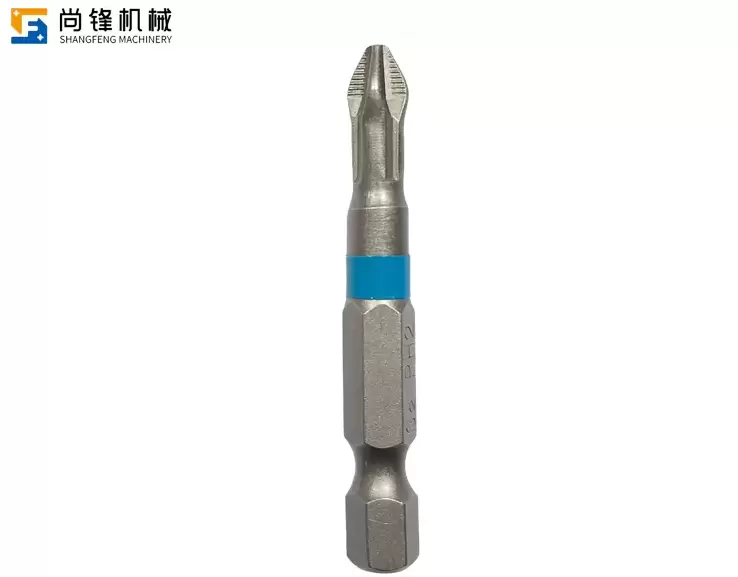
The value of an ACR bit therefore depends on more than the nominal tip size. Geometry, material, heat treatment, dimensional accuracy, surface condition, torque transfer, and the interaction between the bit and screw recess all influence real-world performance.
For manufacturers producing screwdriver bits for global markets, the challenge is to maintain consistent geometry and mechanical properties across large production batches while meeting recognized dimensional and quality requirements.
Shangfeng Machinery Co., Ltd. specializes in screwdriver bits, ratchet screwdrivers, nut sockets, bit holders, quick-change devices, and screwdriver bit sets. The company uses automated tool-production equipment, precision inspection equipment, and Taiwan cold-forging technology, with products manufactured according to DIN and ANSI standards.
Why Anti-Slip Design Matters
During fastening, the driver must transfer rotational torque through a relatively small contact area between the bit and screw recess.
If the engagement is insufficient, increasing torque can cause the bit to climb out of the recess. This is commonly described as cam-out.
Cam-out becomes more likely when the screw is difficult to drive, the driver is misaligned, the applied torque is high, or the recess has already been damaged.
An anti-slip ACR bit is designed to improve engagement between the driver tip and screw recess, helping maintain contact during torque transmission.
The objective is not simply to make the tip more aggressive. The geometry must maintain sufficient contact while controlling stress concentration and wear.
Geometry Determines Torque Transfer
The tip geometry is one of the most important factors affecting fastening performance.
The contact surfaces must match the corresponding screw recess closely enough to transfer torque without excessive localized loading.
If the geometry is too loose, the bit can move inside the recess. If it is too tight or dimensionally inaccurate, insertion can become difficult and the tip may experience excessive stress.
For industrial production, dimensional consistency is therefore critical.
Two bits with the same nominal specification can perform differently if their tip geometry, manufacturing tolerance, or surface condition varies significantly.
Cold Forging Supports Consistent Bit Geometry
Cold forging is widely used for manufacturing high-quality screwdriver bits because it can produce precise metal shapes while maintaining strong material characteristics.
Compared with processes that rely heavily on material removal, cold forming can efficiently produce repeated geometries at high production volumes.
Shangfeng Machinery uses Taiwan cold-forging technology in its screwdriver bit manufacturing process.
For ACR bits with anti-slip design, this type of forming process can support consistent production of the tip geometry, provided that tooling, material preparation, forming parameters, and subsequent heat treatment are properly controlled.
Consistency is particularly important when bits are supplied to automated fastening systems where small dimensional differences can affect tool engagement.
Material Selection Affects Torque Capacity
The steel used for a screwdriver bit must balance hardness and toughness.
A harder bit can provide stronger resistance to wear, but excessive hardness can make the component more susceptible to fracture under high impact or torsional loading.
A softer material may provide greater toughness but can experience faster tip deformation.
The appropriate material and heat-treatment combination therefore depends on the intended application.
For impact drivers, for example, the bit may experience repeated high-frequency torque pulses. A bit intended for manual screwdrivers may experience a substantially different loading profile.
The same geometry should not automatically be assumed to provide identical service life in both applications.
Hardness Must Be Controlled Through the Whole Batch
Heat treatment is a critical manufacturing stage because it determines the mechanical properties of the finished bit.
Inconsistent hardness can produce significant differences in wear resistance and failure behavior between individual bits.
For industrial production, hardness inspection should therefore be part of process control rather than performed only during product development.
Dimensional inspection is equally important because heat treatment can influence final geometry.
A reliable manufacturing process needs to control both mechanical properties and dimensional tolerances.
Anti-Slip Performance and Screw Protection
A high-performance bit should not only protect itself. It should also reduce unnecessary damage to the screw.
If the bit repeatedly slips inside the recess, it can deform the screw head, making subsequent removal more difficult.
This is particularly problematic in applications involving stainless-steel screws, coated fasteners, small electronics screws, furniture hardware, and other products where cosmetic or functional damage is unacceptable.
Improved engagement can help reduce unnecessary movement between the bit and screw during fastening.
However, screw quality also matters. A poorly manufactured or already damaged screw recess cannot be completely compensated for by bit geometry.
Surface Finish Influences Insertion and Wear
The surface condition of the bit can affect friction, insertion behavior, and resistance to corrosion.
A controlled surface finish can provide more consistent interaction between the driver and screw.
Coatings may also be used for specific requirements, such as corrosion resistance or reduced friction.
However, coating thickness must be controlled carefully because excessive coating buildup can alter the effective dimensions of the tip.
For precision screwdriver bits, the final functional geometry should be inspected after all finishing processes have been completed.
Application Conditions Change Bit Performance
An ACR bit used in a low-torque furniture assembly line experiences different conditions from a bit used with a high-torque cordless impact driver.
Fastening speed, screw material, screw size, substrate hardness, driver type, axial pressure, and operating temperature can all influence bit life.
In automated assembly, repeated fastening cycles may expose the bit to thousands of identical operations.
Under these conditions, even a small improvement in wear resistance or engagement consistency can significantly influence the total cost per assembled product.
Manufacturing Quality Controls Matter
For global screwdriver-bit production, quality control must cover raw material, forming, heat treatment, dimensional accuracy, surface condition, and finished-product inspection.
Shangfeng Machinery has introduced automated tool-production equipment and high-precision inspection equipment to support consistent manufacturing.
The company's production follows DIN and ANSI standards for its screwdriver bits and related accessories, providing a recognized reference framework for dimensional and quality requirements.
BSCI certification also supports the company's international supply-chain positioning.
ACR Bits for Professional and Automated Applications
ACR bits with anti-slip design can be considered for applications where stable screw engagement is more important than simply minimizing purchase price.
Furniture assembly, construction, electrical installation, equipment maintenance, appliance manufacturing, and industrial assembly can all involve fastening conditions where cam-out creates additional cost.
In automated environments, consistent bit geometry can be particularly important because the same fastening operation may be repeated thousands of times.
The ideal bit should provide predictable engagement, adequate torque capacity, controlled wear, and compatibility with the selected screw and driver.
Conclusion
ACR bits with anti-slip design are performance components within the complete fastening system. Their effectiveness depends on tip geometry, dimensional accuracy, material selection, heat treatment, surface condition, and compatibility with the screw and driver.
For high-volume manufacturing, consistency is just as important as the performance of an individual sample.
Shangfeng Machinery combines cold-forging technology, automated production equipment, precision inspection, and DIN and ANSI manufacturing standards to produce screwdriver bits and related fastening accessories for global markets.
For applications where cam-out, tip wear, and screw-head damage create measurable production costs, evaluating ACR bit geometry and manufacturing consistency can provide a more meaningful basis for tool selection than comparing nominal size or purchase price alone.