The 3/8 inch adaptor may appear to be a simple accessory within a fastening system, but its influence on torque transmission, tool compatibility, and operational efficiency is far greater than its size suggests. Whether used in automotive repair, industrial equipment assembly, mechanical maintenance, or construction applications, a poorly designed adaptor can become the weakest point in the entire drive system, leading to premature wear, inaccurate torque delivery, or even tool failure.
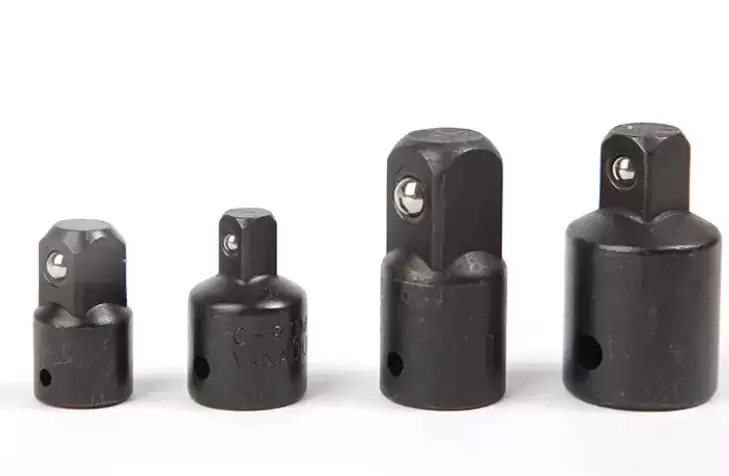
As fastening systems continue to evolve toward higher torque output and greater automation, professional users increasingly expect adaptors to deliver not only dimensional compatibility but also structural reliability under demanding working conditions. Selecting a 3/8 inch adaptor therefore requires understanding far more than the drive size alone.
Why a 3/8 Inch Adaptor Is More Than a Size Converter
Many users consider an adaptor simply as a connector between two different drive sizes. In reality, it functions as a mechanical transmission component that must maintain precise torque transfer while absorbing repeated impact and cyclic loading.
A typical 3/8 inch adaptor may connect:
- 1/4-inch hex screwdriver bits to 3/8-inch square drives
- 3/8-inch sockets to different ratchet sizes
- Impact drivers to socket accessories
- Manual tools to power tools
Every connection introduces another interface where dimensional tolerance, hardness, and concentricity directly affect overall system performance.
Even a slight clearance between mating components can create backlash. Under repeated torque cycles, this movement accelerates wear, increases vibration, and reduces fastening accuracy.
For applications involving hundreds or thousands of fastening cycles each day, adaptor quality becomes an important contributor to tool longevity.
Material Selection Determines Service Life
The mechanical strength of a 3/8 inch adaptor begins with material selection.
Industrial-grade adaptors are typically manufactured from S2 alloy steel, chrome vanadium steel (Cr-V), or chrome molybdenum steel (Cr-Mo) depending on application requirements.
Each material offers different advantages.
S2 steel provides excellent torsional strength and fatigue resistance, making it suitable for precision screwdriver applications.
Chrome vanadium steel offers a balanced combination of hardness, toughness, and corrosion resistance for general industrial fastening.
Chrome molybdenum steel delivers outstanding impact resistance and is widely used in heavy-duty impact socket accessories.
After heat treatment, adaptor hardness generally reaches HRC 58–62 for precision applications while maintaining sufficient toughness to prevent brittle fracture.
Proper heat treatment is equally important. Excessive hardness increases the risk of cracking, while insufficient hardness accelerates drive wear during repeated use.
Manufacturers that maintain strict heat treatment control achieve more consistent service life across large production batches.
Cold Forging Improves Structural Integrity
Manufacturing technology significantly influences adaptor performance.
Compared with conventional machining, cold forging produces a denser grain structure by plastically deforming the metal rather than removing material.
This process offers several mechanical advantages.
The continuous grain flow follows the adaptor geometry, improving torsional strength and fatigue resistance.
Surface finish is generally smoother, reducing stress concentration around corners.
Dimensional consistency also improves, minimizing variation between production batches.
Shangfeng Machinery adopts Taiwan cold forging technology, enabling the production of high-strength screwdriver bits, socket accessories, bit holders, and adaptors that meet international industrial standards.
Cold-forged adaptors typically demonstrate greater resistance to repeated torque loading compared with components manufactured entirely through conventional machining.
Precision Tolerances Improve Torque Transmission
Drive system performance depends heavily on manufacturing accuracy.
The square drive interface must maintain tight dimensional tolerances to minimize rotational clearance while still allowing smooth installation and removal.
Oversized tolerances increase backlash during operation.
Undersized tolerances make assembly difficult and accelerate wear during insertion.
High-quality 3/8 inch adaptors are manufactured according to DIN and ANSI dimensional standards, ensuring compatibility with globally recognized sockets, ratchets, extensions, and power tools.
Precision machining also improves concentricity between the input and output interfaces, reducing vibration during high-speed operation.
For cordless impact tools operating above 2,000 RPM, improved concentricity contributes to smoother power transmission and reduced mechanical stress.
Surface Treatment Extends Durability
Industrial tools frequently operate in environments exposed to humidity, lubricants, metal particles, and chemical contaminants.
Without proper corrosion protection, oxidation gradually reduces dimensional accuracy and weakens surface hardness.
Several surface treatments are commonly applied to premium adaptors.
Black phosphate coatings improve corrosion resistance while reducing light reflection.
Nickel plating enhances appearance and provides additional protection against moisture.
Chrome plating offers excellent corrosion resistance for manual hand tools.
Some industrial users also prefer manganese phosphate finishes because they retain lubrication effectively under repeated mechanical loading.
Selecting an appropriate surface treatment depends on operating conditions rather than appearance alone.
Impact Resistance Is Increasingly Important
Modern cordless impact wrenches and impact drivers generate substantially higher torque than traditional hand tools.
Professional impact tools can produce outputs exceeding 300 Nm, while heavy-duty industrial systems may exceed 1,000 Nm.
These repeated impact loads place enormous stress on adaptor connections.
Impact-rated 3/8 inch adaptors therefore require thicker cross-sections, optimized corner radii, and materials capable of absorbing shock loads without permanent deformation.
Using standard manual adaptors with impact tools significantly increases the risk of cracking or premature wear.
Choosing adaptors specifically designed for impact applications improves both operator safety and equipment reliability.
Compatibility Supports Flexible Tool Systems
One of the greatest advantages of the 3/8 inch adaptor is its ability to expand tool compatibility.
Rather than purchasing multiple dedicated tools, users can connect various sockets, extensions, bit holders, and fastening accessories through standardized drive interfaces.
This flexibility reduces equipment investment while improving workflow efficiency across maintenance, assembly, and repair operations.
Compatibility becomes especially valuable in industries where technicians frequently switch between manual ratchets, electric screwdrivers, pneumatic tools, and cordless impact drivers.
A precisely manufactured adaptor ensures consistent torque transfer regardless of the drive source.
Manufacturing Consistency Ensures Reliable Performance
For industrial distributors and OEM tool brands, product consistency is often more important than peak performance.
Each adaptor within a shipment should exhibit identical hardness, dimensional accuracy, and torque capacity.
Shangfeng Machinery combines automated manufacturing equipment with high-precision inspection systems to ensure stable production quality.
Products are manufactured according to DIN and ANSI standards, allowing compatibility with internationally recognized fastening systems.
The company's product portfolio extends beyond adaptors to include screwdriver bits, ratcheting screwdrivers, nut setters, bit holders, quick-change systems, and complete screwdriver bit sets, providing integrated fastening solutions for global markets.
In addition, BSCI certification reflects the company's commitment to responsible manufacturing practices and international supply chain standards.
Conclusion
Although compact in size, a 3/8 inch adaptor plays a critical role in determining the efficiency, durability, and safety of fastening systems. Material quality, cold forging technology, precision machining, heat treatment, and dimensional consistency all influence its ability to transmit torque reliably under demanding industrial conditions.
As fastening applications continue to require higher torque, faster assembly speeds, and broader tool compatibility, selecting a professionally manufactured adaptor becomes increasingly important.
With advanced automated production equipment, Taiwan cold forging technology, precision inspection systems, and manufacturing in accordance with DIN and ANSI standards, Shangfeng Machinery Co., Ltd. delivers high-quality 3/8 inch adaptor solutions designed for long service life, reliable torque transmission, and compatibility with professional fastening systems worldwide.

 EN
EN


