
 EN
EN


The 3/8 inch adaptor is one of the most frequently used accessories in modern fastening systems. From automotive repair and industrial assembly to construction equipment maintenance and manufacturing production lines, it serves as the connection between tools with different drive interfaces while ensuring efficient torque transmission. Although small in size, the adaptor directly influences fastening accuracy, tool life, and overall operating efficiency.
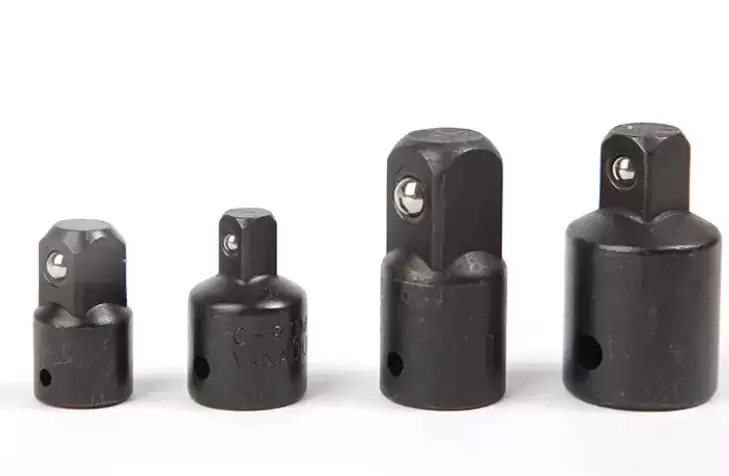
As cordless impact tools continue to deliver higher torque and faster fastening speeds, the performance requirements for adaptors have become significantly more demanding. Selecting the right 3/8 inch adaptor is no longer simply about matching drive sizes. Material strength, manufacturing precision, heat treatment, and compatibility with high-torque applications all determine whether the adaptor can perform reliably over thousands of fastening cycles.
Understanding the Function of a 3/8 Inch Adaptor
A 3/8 inch adaptor connects tools with different drive standards, allowing one drive system to work with multiple sockets, screwdriver bits, extensions, or accessories.
Common applications include connecting:
- 1/4-inch hex bits to 3/8-inch square drive sockets
- 3/8-inch ratchets to various socket accessories
- Impact drivers to socket systems
- Power tools to manual fastening accessories
Because torque passes through every connection point, the adaptor becomes part of the load-bearing structure rather than simply acting as an accessory.
During repeated tightening and loosening operations, the adaptor must withstand torsional stress, impact loading, and continuous insertion and removal without losing dimensional accuracy.
Torque Capacity Depends on Structural Design
Many adaptor failures are not caused by excessive torque alone but by stress concentration within the drive geometry.
The square drive corners experience the highest stress during operation. If these areas are poorly designed or manufactured with inconsistent dimensions, cracks may develop after repeated loading.
Professional-grade adaptors are designed with optimized corner transitions that distribute stress more evenly throughout the component.
At the same time, the wall thickness surrounding the drive interface must balance two competing requirements. Excessive thickness increases weight and reduces accessibility in confined spaces, while insufficient thickness lowers torsional strength.
Engineering optimization allows modern adaptors to maintain compact dimensions while supporting the higher torque generated by today's cordless impact tools.
Precision Manufacturing Reduces Mechanical Wear
Dimensional accuracy is one of the most important quality indicators for a 3/8 inch adaptor.
If the square drive opening exceeds standard tolerance, slight rotational movement develops between the adaptor and socket. Although this clearance may initially appear insignificant, repeated torque cycles gradually enlarge the contact surfaces.
The consequences include:
- Faster wear of drive corners
- Reduced torque transmission efficiency
- Increased vibration during operation
- Difficulty maintaining accurate tightening torque
Conversely, if tolerances are too tight, installation becomes difficult and excessive insertion force accelerates wear on both the adaptor and mating tools.
Professional manufacturers maintain dimensional consistency according to DIN and ANSI standards, ensuring reliable compatibility with globally available ratchets, sockets, extensions, and power tools.
This consistency becomes particularly valuable for industrial users operating large inventories of fastening equipment from multiple brands.
Material and Heat Treatment Influence Fatigue Resistance
Industrial fastening tools experience repeated cyclic loading rather than single high-load events.
Over thousands of tightening operations, microscopic fatigue cracks may develop if the material lacks sufficient toughness.
High-performance 3/8 inch adaptors commonly use alloy steels such as S2, chrome vanadium (Cr-V), or chrome molybdenum (Cr-Mo).
Each material is selected according to its intended application.
S2 steel provides excellent torsional performance for precision fastening.
Chrome vanadium combines wear resistance with balanced mechanical strength for general-purpose applications.
Chrome molybdenum is widely used for impact-rated accessories because of its outstanding resistance to repeated shock loading.
Heat treatment is carefully controlled to achieve hardness levels typically between HRC 58 and HRC 62, allowing the adaptor to resist wear while maintaining sufficient toughness to absorb high torque without brittle fracture.
Uniform heat treatment also ensures consistent mechanical performance across large production batches.
Cold Forging Creates Stronger Components
Manufacturing technology has a direct influence on adaptor durability.
Cold forging differs significantly from conventional machining by reshaping metal instead of removing it.
During cold forging, the internal grain flow follows the final geometry of the adaptor, improving structural continuity throughout the component.
This manufacturing method provides several advantages:
Higher torsional strength enables the adaptor to withstand repeated tightening cycles with reduced fatigue risk.
Improved dimensional consistency minimizes variation between production batches.
Reduced material waste also improves manufacturing efficiency while supporting cost-effective large-scale production.
Shangfeng Machinery utilizes advanced Taiwan cold forging technology together with automated manufacturing equipment to produce fastening accessories with stable mechanical properties and consistent dimensional accuracy.
Surface Protection Extends Service Life
Industrial environments expose fastening tools to moisture, oils, chemicals, and abrasive contaminants.
Without effective surface protection, corrosion gradually affects dimensional precision and increases friction during tool engagement.
Depending on the application, premium adaptors may receive:
Black phosphate coatings for improved corrosion resistance and reduced glare.
Nickel plating for enhanced corrosion protection and attractive appearance.
Chrome plating for long-term durability in manual tool applications.
Proper surface finishing not only improves appearance but also helps preserve precise drive dimensions throughout extended service life.
Selecting the Right Adaptor for Different Applications
Not every 3/8 inch adaptor is suitable for every working environment.
Manual fastening generally prioritizes dimensional precision and long-term wear resistance.
Cordless impact drivers require adaptors capable of absorbing repeated impact energy without deformation.
Automotive maintenance often demands corrosion resistance because tools are regularly exposed to lubricants, brake fluids, and outdoor environments.
Industrial production lines place greater emphasis on repeatability, dimensional consistency, and compatibility with automated fastening equipment.
Matching adaptor specifications to actual operating conditions improves both productivity and tool longevity.
Manufacturing Quality Supports Global Tool Compatibility
For OEM tool brands, distributors, and industrial users, consistency across every production batch is essential.
Reliable manufacturing requires precise control over raw materials, cold forging, heat treatment, machining, surface finishing, and final inspection.
Shangfeng Machinery has established automated production lines supported by high-precision inspection equipment to ensure every adaptor meets international quality requirements.
The company's products are manufactured according to DIN and ANSI standards, ensuring compatibility with a wide range of professional fastening systems worldwide.
Beyond 3/8 inch adaptors, Shangfeng Machinery also manufactures screwdriver bits, ratcheting screwdrivers, nut setters, bit holders, quick-change systems, and screwdriver bit sets, providing complete fastening solutions for industrial and commercial markets.
Its BSCI certification further demonstrates its commitment to responsible manufacturing and stable global supply capabilities.
Conclusion
Choosing a 3/8 inch adaptor involves much more than selecting the correct drive size. Material quality, cold forging technology, precision machining, heat treatment, structural design, and compliance with international standards all influence long-term performance.
As fastening applications continue to demand higher torque, greater efficiency, and broader compatibility, professionally engineered adaptors deliver measurable advantages in durability, accuracy, and operational reliability.
With advanced manufacturing technology, automated quality control, Taiwan cold forging expertise, and production in accordance with DIN and ANSI standards, Shangfeng Machinery Co., Ltd. provides 3/8 inch adaptor solutions designed to meet the performance requirements of modern industrial fastening systems while supporting long-term reliability across global markets.