
 EN
EN


ACR bits with high torque capacity are designed for screwdriving applications where standard Phillips bits can struggle with cam-out, recess damage, premature tip wear, or inconsistent torque transfer. The ACR concept uses anti-cam-out ribs on the driver tip to increase engagement with a compatible ribbed screw recess. When combined with suitable bit geometry, heat treatment, material selection, and a properly controlled manufacturing process, this design can improve driving stability under demanding torque conditions. ACR is a registered trademark of Phillips Screw Company, and manufacturers such as Wera and Apex offer ACR-compatible driver-bit configurations for industrial applications.
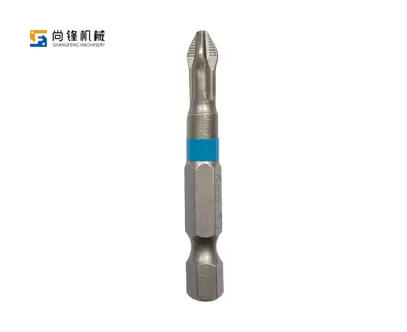
For applications involving coated fasteners, automated screwdriving, repeated assembly cycles, or relatively high installation torque, the important question is not simply whether a bit is labeled “ACR.” The actual performance depends on the interface between the bit and screw recess, bit hardness and toughness, drive geometry, applied axial load, rotational speed, and the torque level required by the fastening process.
Why High Torque Changes Bit Requirements
Torque is transferred through a relatively small contact area between the bit and screw recess. As torque increases, the interface is subjected to higher contact stress. If the bit cannot maintain sufficient engagement, it can climb out of the recess instead of transferring torque efficiently.
This phenomenon is commonly known as cam-out. ACR ribs are intended to increase resistance to this type of slipping by engaging the corresponding recess geometry. Wera describes ACR as “anti-cam-out ribs” designed to prevent the bit from slipping out of the screw head and recommends matching ACR bits with ribbed ACR screws for maximum effect.
This distinction is important for high-torque applications because increasing motor torque alone does not necessarily improve fastening performance. If the bit-recess interface loses engagement, additional torque can accelerate recess deformation, tip wear, or fastener damage.
ACR Engagement Depends on the Screw
The ACR system is most effective when the driver and fastener are designed to work together.
The ribs on the bit interact with the corresponding features inside an ACR screw recess. This creates additional engagement points compared with a conventional smooth Phillips interface. Semblex describes its ACR Phillips II system as using vertical ribs within the Phillips recess and mating ribbed driver bits to resist cam-out and improve torque transmission.
This means an ACR bit should not be evaluated independently from the screw.
If a standard Phillips screw is used with an ACR bit, the expected anti-cam-out effect may not be fully achieved because the recess does not provide the corresponding rib geometry. For a production application, the fastener and bit combination should therefore be qualified as a complete drive system.
High Torque Capacity Is More Than Hardness
Bit hardness is an important parameter, but maximum hardness does not automatically produce the best high-torque bit.
A bit that is excessively hard can resist surface deformation but may become less tolerant of impact or torsional shock. A bit that is too soft may deform rapidly under repeated high loads.
The practical target is a balance between hardness, toughness, wear resistance, and controlled deformation.
This becomes particularly important in power-tool applications where torque is delivered rapidly. A manual screwdriver may apply torque relatively gradually, while an impact or high-speed electric driver can introduce short-duration torque peaks. A bit must survive not only the nominal fastening torque but also these transient loads.
Some industrial bit designs therefore incorporate a torsion zone specifically to absorb peak loads. Wera, for example, describes its TZ ACR bits as combining anti-cam-out ribs with a torsion zone intended to absorb damaging peak torque loads.
Cold Forging and Dimensional Consistency
For a manufacturer of ACR bits with high torque capacity, forming accuracy is closely related to driving performance.
Shangfeng Machinery uses Taiwan cold-forging technology for screwdriver-bit production and manufactures products according to DIN and ANSI standards. Cold forming can provide a controlled method for producing repeatable shank and tip geometries while maintaining consistent dimensions across production batches.
This is particularly relevant to ACR tips because the rib profile must engage the screw recess correctly. Excessive dimensional variation can change contact conditions between the bit and fastener, potentially producing uneven load distribution.
A technically controlled manufacturing process should therefore consider tip geometry, shank dimensions, concentricity, surface condition, heat treatment, and final inspection rather than relying only on visual inspection.
Why Tip Geometry Matters Under Torque
A high-torque bit transfers force through its working surfaces. If the tip does not fully seat into the recess, the effective contact area decreases and localized stress increases.
For Phillips-based ACR systems, the tip size must match the screw recess. A #2 bit should be selected for the corresponding #2 drive specification rather than assuming that a larger bit will provide more torque capacity.
Apex's industrial ACR insert-bit range, for example, includes different Phillips point sizes and configurations, including #1, #2, and #3 versions, with 1/4-inch and 5/16-inch hex-drive options depending on the product family.
This illustrates an important engineering principle: torque capability should be considered together with drive size and fastener geometry. A larger shank does not compensate for an incorrectly matched tip.
Coated and Corroded Fasteners Create Additional Risk
High-torque applications often involve fasteners that are not in ideal surface condition.
Paint, coatings, oxidation, contamination, and debris can prevent the bit from seating completely inside the recess. This reduces effective contact and increases the possibility of cam-out.
Apex specifically identifies painted, coated, or corroded fasteners as situations in which ACR ribs can help reduce stripping and cam-out.
The same issue can occur in outdoor equipment, construction assemblies, metal fabrication, transportation equipment, and maintenance applications where fasteners may have been exposed to environmental conditions.
In these situations, the correct bit should be evaluated not only under clean laboratory conditions but also against the actual fastener surface condition encountered in production.
High-Torque Bits for Automated Assembly
Automation places additional demands on ACR bits.
In a manual application, an operator can compensate for poor engagement by adjusting tool angle or applying additional axial pressure. An automated screwdriver has less ability to compensate for a poorly seated bit.
The screw feeder, driver spindle, bit holder, fastener presentation, tool alignment, rotational speed, and torque-control system all influence the final result.
Semblex identifies reduced end-load requirements, resistance to cam-out, extended tool life, and faster automated assembly as benefits associated with its ACR Phillips II system.
For high-volume production, reducing cam-out can have an effect beyond bit consumption. A cam-out event can damage the fastener head, damage the surrounding product surface, interrupt the assembly cycle, and create additional inspection or rework requirements.
Bit Life Should Be Measured by More Than Number of Screws
A common way to evaluate driver bits is to measure how many screws can be installed before replacement.
That metric is useful, but it should not be the only measurement.
A production trial should also evaluate torque consistency, recess damage, tip wear, cam-out frequency, bit breakage, and the number of rejected assemblies.
For example, a bit that survives 2,000 cycles but gradually produces increasing recess damage may be less suitable for a precision assembly than a bit that maintains stable engagement over a shorter but more predictable service interval.
A useful test therefore compares both durability and fastening quality.
ACR Bits vs. Conventional Phillips Bits
The primary difference is the drive-interface design.
A conventional Phillips bit relies on the standard cruciform recess geometry. Under certain torque and alignment conditions, the interface can experience cam-out. An ACR bit adds ribs designed to increase engagement with a compatible ribbed recess.
This does not mean that ACR bits eliminate all cam-out under every operating condition. Excessive torque, incorrect bit size, poor alignment, damaged screws, insufficient seating, or incompatible fasteners can still cause failure.
The correct comparison is therefore application-specific: standard Phillips for general fastening versus an ACR system where additional resistance to cam-out and improved torque transfer are required.
Selecting an ACR Bit for High-Torque Applications
A practical specification should define the screw drive type, ACR compatibility, point size, shank configuration, overall length, material, heat-treatment condition, hardness range, required torque level, tool interface, and intended driving method.
For automated assembly, rotational speed, duty cycle, axial force, torque-control strategy, and expected number of fastening cycles should also be considered.
A 25 mm 1/4-inch hex bit may be appropriate for compact power-tool applications, while a longer 50 mm or 70 mm configuration may be needed for recessed fastening positions. Commercial ACR products are available in multiple lengths and 1/4-inch hex configurations for different access requirements.
The correct configuration should therefore be selected from the actual fastening geometry rather than from length or torque rating alone.
Shangfeng Machinery's Manufacturing Approach
Shangfeng Machinery Co., Ltd. specializes in screwdriver bits, ratchet screwdrivers, nut sockets, bit holders, quick-change devices, and screwdriver-bit sets.
The company uses automated tool-production equipment, high-precision inspection equipment, and Taiwan cold-forging technology, with production based on DIN and ANSI standards. Its product range is supplied to customers worldwide, and the company has BSCI certification.
For ACR bits with high torque capacity, this manufacturing infrastructure is relevant because repeatable geometry and process control are essential to maintaining consistent bit-to-recess engagement. The combination of cold forming, controlled heat treatment, dimensional inspection, and production consistency provides a foundation for applications where repeated torque transfer is more demanding than general-purpose screwdriving.
Conclusion
ACR bits with high torque capacity should be evaluated as part of a complete fastening system rather than as a simple upgrade to a conventional Phillips bit.
The ACR rib structure can improve engagement with compatible ribbed screw recesses and reduce cam-out, while material selection, hardness, toughness, torsional behavior, tip geometry, and manufacturing accuracy determine whether that interface remains reliable under repeated load.
For demanding applications, the most useful qualification process combines actual fasteners, actual driving equipment, required torque, production speed, cycle count, and environmental conditions. This provides a much clearer picture of whether an ACR bit can maintain torque transfer, protect the fastener recess, and deliver consistent service life.