
 EN


A 1/2 inch adaptor is a small but important component in power tool and socket drive systems. It connects accessories with different drive interfaces, allowing users to combine impact drivers, ratchets, power tools, and socket attachments within one working setup. Although its structure appears simple, the adaptor directly affects torque transmission, connection stability, wear resistance, and operating safety. An unsuitable adaptor can introduce excessive play, accelerate interface wear, or fail under repeated load, resulting in downtime and potential damage to connected tools.
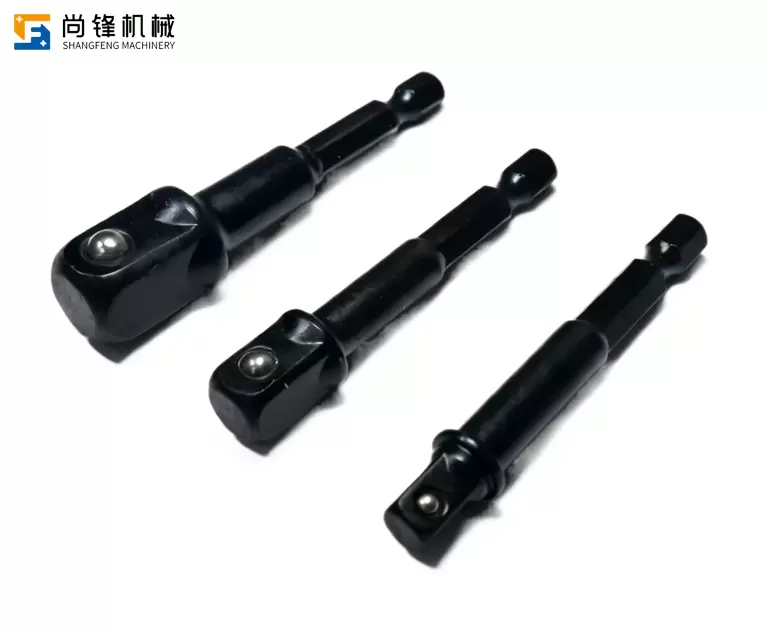
For professional tool manufacturers and distributors, selecting a suitable 1/2 inch adaptor requires more than confirming the nominal drive size. Drive configuration, material strength, manufacturing precision, heat treatment, and application conditions all influence actual performance.
Understanding the 1/2 Inch Drive Interface
The term 1/2 inch generally refers to the nominal square drive size used to connect sockets and compatible accessories. It is widely used in automotive maintenance, mechanical assembly, industrial equipment servicing, and other applications requiring relatively high torque.
A 1/2 inch adaptor can serve different connection purposes. Some designs convert a square drive to a hexagonal bit interface, allowing screwdriver bits to be used with a ratchet or power tool. Others connect different square drive sizes or provide a specific extension or conversion function. These products may share the same nominal drive dimension but differ considerably in structure and intended use.
Before selecting an adaptor, it is necessary to confirm both ends of the connection. For example, a 1/2 inch square drive to 1/4 inch hex adaptor is different from a 1/2 inch square drive to 3/8 inch square drive reducer. The first is generally used to connect hex-shank bits to a square-drive tool, while the second changes the socket drive size. Confusing these configurations can result in incompatible assemblies or unsuitable load distribution.
The connection mechanism should also be checked. A detent ball, spring-loaded retention system, or other locking structure may be used to keep the attached socket or accessory in position. In applications involving vibration or frequent accessory changes, reliable retention is particularly important.
Torque Transmission and Structural Strength
Torque capacity is one of the most important considerations when evaluating a 1/2 inch adaptor. During operation, the adaptor transfers rotational force between the driving tool and the connected accessory. The interface must withstand both normal working loads and the transient stresses generated by tightening or loosening fasteners.
Material selection plays a major role in this process. Chrome vanadium steel (Cr-V) is commonly used in hand-tool accessories because of its strength, toughness, and suitability for heat treatment. Chrome molybdenum steel (Cr-Mo) is frequently selected for impact-rated accessories because of its toughness and ability to withstand repeated impact loading when properly processed.
However, material designation alone does not establish product performance. Steel composition, forging quality, heat-treatment consistency, surface defects, and dimensional accuracy all affect the finished component. A poorly controlled heat-treatment process may produce excessive brittleness or insufficient hardness, either of which can reduce service life.
It is also important to distinguish between adaptors designed for manual tools and those intended for impact applications. An adaptor used with a hand ratchet may experience relatively controlled torque loading. An impact-rated adaptor must withstand repeated high-energy impulses, which place different demands on material toughness and structural design. A standard hand-tool adaptor should not be assumed to be suitable for impact wrench operation unless the manufacturer explicitly rates it for that application.
Why Manufacturing Precision Matters
A 1/2 inch adaptor depends on accurate mating surfaces to transmit torque efficiently. If the square drive is oversized, undersized, or poorly finished, the connected socket may not fit correctly. Excessive clearance can create backlash and concentrate stress around the drive corners, while an overly tight interface can make accessory installation and removal difficult.
Cold forging is a widely used manufacturing method for producing high-volume tool accessories. Compared with machining a component entirely from solid stock, cold forging can improve material utilization and support consistent forming of complex geometries. When supported by appropriate tooling and process control, it can also provide a strong foundation for repeatable production.
Shangfeng Machinery Co., Ltd. uses Taiwanese cold forging technology and automated tool manufacturing equipment to produce screwdriver bits and related accessories. The company also employs high-precision inspection equipment and manufactures products according to relevant DIN and ANSI standards. For adaptor production, such manufacturing capabilities are valuable because they support dimensional consistency and controlled product quality across batches.
Inspection should cover critical dimensions, drive geometry, surface finish, and connection fit. For products designed for impact applications, additional testing should verify resistance to repeated loading and structural failure. The exact acceptance criteria should correspond to the product design and declared application.
Surface Treatment and Corrosion Resistance
Surface treatment affects both product appearance and service life. Tool adaptors may be exposed to workshop moisture, oils, dirt, and frequent handling. Without suitable surface protection, corrosion can develop during storage or use, particularly in humid environments.
Common finishes include black oxide, phosphate treatment, and other protective coatings. The choice depends on the required corrosion resistance, appearance, friction characteristics, and cost. Surface treatment should be evaluated alongside dimensional tolerances because excessive coating thickness can affect the fit of precision drive interfaces.
For products supplied in sets or distributed through international channels, consistent surface color and finish also influence perceived quality. Batch inspection should therefore consider coating uniformity, visible defects, and resistance to the environmental conditions specified for the product.
Selecting an Adaptor for Different Applications
Automotive repair often requires adaptors that can accommodate different socket and bit configurations in confined spaces. In these situations, connection stability and dimensional compatibility are essential. For industrial maintenance, repeated use and higher mechanical loads make material toughness and manufacturing consistency more significant.
For general workshop applications, a 1/2 inch square drive to hex bit adaptor can expand the compatibility of existing tool systems. However, the hex interface, retention mechanism, and intended torque range must match the connected bits and driving equipment. For heavy-duty applications, the product should be selected according to its impact rating and manufacturer test data rather than nominal size alone.
A practical evaluation should include dimensional verification, fit testing with compatible tools, retention checks, and load testing under representative operating conditions. This approach helps identify problems before the adaptor is introduced into regular service.
Building Consistent Tool Accessories with Shangfeng Machinery
Shangfeng Machinery specializes in screwdriver bits, ratchet screwdrivers, nut sockets, bit holders, quick-change devices, screwdriver bit sets, and related accessories. Its manufacturing operations combine automated production equipment, high-precision inspection systems, and Taiwanese cold forging technology. The company produces screwdriver bits and associated accessories according to DIN and ANSI standards and holds BSCI certification.
For a 1/2 inch adaptor, these manufacturing principles support the requirements that matter most: accurate interfaces, consistent dimensions, reliable material processing, and repeatable production quality. When evaluating a supplier, buyers should confirm the exact adaptor configuration, material grade, heat-treatment requirements, applicable standards, and whether the product is designed for manual or impact use.
A reliable 1/2 inch adaptor is not simply a size converter. It is a load-bearing connection within a larger tool system. Matching its design and manufacturing quality to the actual application helps improve compatibility, reduce premature wear, and maintain dependable performance throughout repeated tool operations.