
 EN


Impact tools are widely used in automotive repair, equipment maintenance, construction, and industrial assembly because they deliver high rotational force through repeated mechanical impulses. In these applications, a 1/2 inch adaptor must do more than connect two tool interfaces. It needs to transfer torque reliably while resisting impact fatigue, deformation, and premature wear. Selecting the wrong adaptor can lead to damaged drive corners, loose connections, accessory separation, or unexpected component failure.
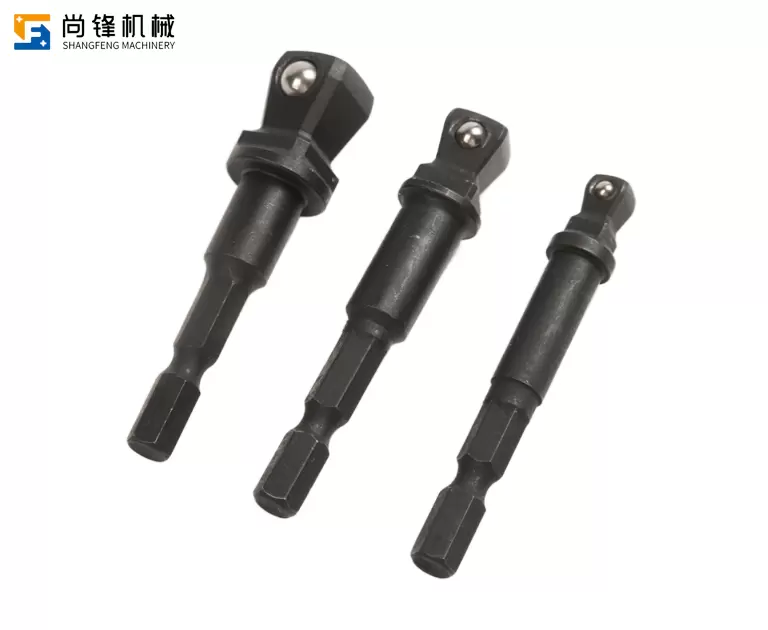
As power tools become more widely used across professional workshops, the difference between a standard hand-tool adaptor and an impact-rated adaptor has become increasingly important. Material selection, structural geometry, heat treatment, and manufacturing control should all be considered when developing or sourcing adaptors for demanding operating conditions.
How Impact Loading Affects a 1/2 Inch Adaptor
Unlike a manual ratchet, which generally applies force through a relatively controlled rotational movement, an impact wrench delivers a series of short, high-energy impulses. These repeated impacts create fluctuating stresses throughout the adaptor, particularly around the drive interface, corners, transitions, and changes in cross-section.
The 1/2 inch square drive is responsible for transmitting torque to the connected socket or accessory. If the drive geometry is inaccurate, the load may become unevenly distributed across the contact surfaces. Over time, this can cause corner deformation, increased clearance, and reduced connection stability.
Stress concentration is another concern. Abrupt changes in section thickness, sharp internal transitions, and poorly formed geometries can create localized high-stress areas. Under repeated impact loading, these areas may become potential points of fatigue failure. A well-designed adaptor should therefore balance compact dimensions with sufficient structural strength and suitable transition geometry.
The overall assembly also matters. An adaptor's performance is influenced by the driving tool, connected socket or bit, fastener condition, and operating technique. Even a properly manufactured adaptor can fail if it is used beyond its intended torque or impact rating.
Material Selection: Cr-V or Cr-Mo?
Steel selection is a fundamental decision in impact accessory manufacturing. Chrome vanadium steel and chrome molybdenum steel are both common in professional tool products, but their properties and typical applications differ.
Cr-V steel is frequently used in hand-tool accessories because it offers a useful combination of strength, hardness, and wear resistance after suitable heat treatment. It is suitable for many sockets, ratchet accessories, and general-purpose adaptors designed for controlled manual operation.
Cr-Mo steel is widely used in impact-rated sockets and accessories because its alloy composition can support good toughness and resistance to repeated impact loading when processed correctly. For adaptors intended for impact wrenches, toughness is particularly important because the component must withstand repeated stress cycles rather than a single static load.
Neither material should be selected based on its name alone. Actual performance depends on steel grade, chemical composition, forging quality, heat-treatment parameters, and final mechanical properties. Manufacturers should provide material specifications and relevant test information for products intended for demanding applications.
Hardness also requires careful control. Excessive hardness may improve resistance to surface deformation but can reduce impact toughness if the heat-treatment process is unsuitable. Insufficient hardness may lead to premature wear or deformation of the drive interface. A balanced combination of hardness and toughness is therefore more meaningful than maximizing either property independently.
Cold Forging and Dimensional Accuracy
Cold forging is an important manufacturing process for many high-volume hand-tool accessories. By forming metal under controlled pressure, manufacturers can create repeatable component geometries while making efficient use of raw material. The process is particularly relevant to products requiring consistent external dimensions and well-defined drive interfaces.
However, forging quality depends on more than the forming equipment itself. Material preparation, die condition, forming pressure, process stability, and subsequent machining or finishing operations all affect the final product. Defects such as incomplete filling, surface cracks, folds, or dimensional deviations must be controlled through process inspection.
For a 1/2 inch adaptor, critical dimensions include the square drive size, interface depth, hexagonal or square connection dimensions, and retention feature geometry. These dimensions determine whether the adaptor fits correctly and maintains stable engagement with the connected accessory.
Shangfeng Machinery Co., Ltd. uses Taiwanese cold forging technology, automated tool manufacturing equipment, and high-precision inspection equipment in its production of screwdriver bits and related accessories. The company follows relevant DIN and ANSI standards for its screwdriver bits and associated products. This manufacturing background is relevant when evaluating suppliers that produce precision tool accessories, although the applicable standard and inspection requirements should always be confirmed for each specific adaptor model.
Retention Design and Connection Reliability
A 1/2 inch adaptor may use different retention structures depending on its intended application. Detent balls, spring-loaded mechanisms, retaining rings, or other locking designs help prevent sockets and accessories from separating during operation.
The retention system must provide a suitable balance between holding force and ease of removal. If retention is too weak, the accessory may become loose under vibration or repeated handling. If it is excessively tight, users may find it difficult to change sockets or bits, reducing operating efficiency.
For impact applications, retention performance should be tested under representative vibration and loading conditions. The design must also consider wear after repeated attachment and removal cycles. A mechanism that works correctly when new may lose holding force if its spring, ball, or contact surfaces deteriorate prematurely.
Compatibility should be clearly specified. A 1/2 inch square drive adaptor does not automatically fit every socket or bit system. The drive configuration, connection dimensions, and retention method must match the intended accessories.
Testing Requirements for Impact-Rated Adaptors
A reliable testing program should reflect the actual working conditions of the product. Dimensional inspection verifies the accuracy of the drive interfaces, while fit testing confirms compatibility with designated tools and accessories. Retention testing evaluates whether the connected component remains securely attached during normal operation.
For impact-rated products, repeated impact testing is particularly important. The test should use a defined tool configuration, operating conditions, and test duration, with inspection before and after testing. Relevant observations may include deformation, cracks, drive wear, looseness, and changes in connection performance.
Corrosion resistance should also be considered for accessories exposed to workshop moisture or long-term storage. Surface treatments such as black oxide or other protective finishes may help reduce corrosion, but their performance depends on process quality and environmental exposure. Coating thickness must also be controlled to avoid affecting precision mating dimensions.
Suppliers should be able to explain the test method and acceptance criteria rather than relying on general descriptions such as heavy-duty or industrial-grade. Where an adaptor is marketed for impact use, its intended application and limitations should be clearly documented.
Choosing the Right 1/2 Inch Adaptor for Professional Tool Systems
The correct adaptor depends on the complete tool configuration. For hand ratchets and controlled manual work, a standard adaptor with suitable material properties and accurate drive geometry may be sufficient. For impact wrenches, the adaptor must be specifically designed and tested for repeated impact loading.
Before finalizing a specification, manufacturers and buyers should confirm the input and output interfaces, material grade, heat-treatment requirements, retention design, surface finish, and intended operating conditions. They should also verify whether the product is covered by a relevant dimensional or performance standard. DIN and ANSI standards cover different tool categories and specifications, so a general statement of compliance should not replace confirmation of the exact standard applicable to the product.
Shangfeng Machinery specializes in screwdriver bits, ratchet screwdrivers, nut sockets, bit holders, quick-change devices, and screwdriver bit sets. With automated production equipment, high-precision inspection systems, and Taiwanese cold forging technology, the company focuses on manufacturing consistent tool accessories for international markets. Its BSCI certification also supports its commitment to responsible manufacturing practices.
A dependable 1/2 inch adaptor for impact tools requires the right combination of material toughness, structural design, precise interfaces, and validated testing. By evaluating these factors together, manufacturers can reduce connection-related failures, improve accessory compatibility, and build tool systems capable of handling demanding maintenance and assembly work.