
 EN
EN


In industrial fastening systems, the slotted screwdriver bit remains one of the most widely used torque transfer interfaces, despite the rise of more advanced drive geometries such as Phillips, Torx, and Pozidriv. Its continued relevance is driven by compatibility with legacy equipment, electrical installations, control panels, and general maintenance applications across global industries.
However, while the geometry appears simple, the engineering requirements behind a high-performance slotted bit are far from basic. Torque stability, edge wear resistance, hardness uniformity, and dimensional precision all determine whether the tool performs reliably under repeated industrial use.
Shangfeng Machinery Co., Ltd., with its cold forging manufacturing process and DIN/ANSI compliance systems, focuses on improving the structural consistency and durability of slotted screwdriver bits through controlled material processing and precision forming techniques.
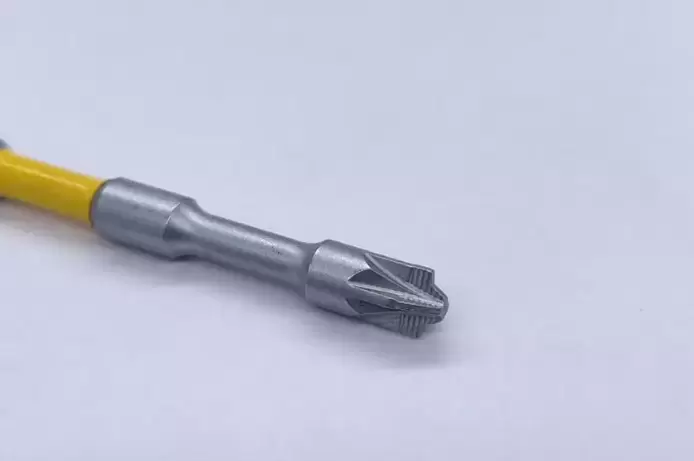
Geometry control and dimensional accuracy in slotted bit design
Unlike multi-lobed drive systems, the slotted screwdriver bit relies on a single contact plane between the tool and fastener. This makes dimensional accuracy critical, as even small deviations in width or thickness can lead to cam-out or slot deformation.
Typical industrial dimensional tolerances include:
- Tip width tolerance: ±0.02–0.05 mm depending on size class
- Blade thickness deviation: controlled within ±0.03 mm
- Edge parallelism deviation: ≤0.02 mm over working length
These tolerances ensure stable contact pressure distribution during torque application.
Improper geometry leads to uneven load concentration on one edge of the slot, significantly increasing wear rate and reducing fastener life cycle.
Cold forging technology used in precision manufacturing improves grain alignment along the tool axis, enhancing both dimensional stability and mechanical strength.
Torque transfer efficiency and cam-out resistance
One of the most critical performance challenges for a slotted screwdriver bit is cam-out behavior under torque load.
Because force is applied along a single axis, torque transfer efficiency is highly sensitive to contact geometry and material hardness.
Typical industrial performance parameters include:
- Maximum torque resistance: 1.5–6.0 Nm depending on bit size
- Cam-out threshold: influenced by tip angle precision (typically 0–0.5° deviation control)
- Contact pressure distribution: optimized through edge reinforcement geometry
When torque exceeds the mechanical stability threshold, the bit tends to slip out of the slot, causing both tool wear and fastener damage.
To mitigate this, modern slotted bits incorporate micro-geometry optimization at the tip edges, improving surface engagement without increasing overall thickness.
Material selection and hardness optimization
Material composition plays a decisive role in slotted screwdriver bit performance.
High-quality industrial bits typically use alloy steels with controlled carbon content, followed by heat treatment processes such as quenching and tempering.
Key performance indicators include:
- Surface hardness: HRC 58–62 for industrial-grade applications
- Core toughness: maintained to prevent brittle fracture under peak torque
- Wear resistance: optimized through controlled heat treatment cycles
Shangfeng Machinery applies a cold forging process prior to heat treatment, which improves internal grain density and reduces micro-void formation. This directly enhances fatigue resistance during repeated torque cycles.
Improper heat treatment can result in surface cracking or premature edge rounding, both of which significantly reduce operational lifespan.
Manufacturing process control and cold forging advantages
Cold forging is a critical manufacturing method in high-quality slotted screwdriver bit production.
Compared with machining-based forming, cold forging provides:
- Improved grain flow alignment along stress direction
- Higher material density at the working tip
- Reduced internal defects such as porosity or micro-cracks
- Better dimensional repeatability in mass production
After forging, precision grinding is used to finalize tip geometry within strict tolerances.
This combination of forging and finishing ensures both structural strength and dimensional accuracy, which is essential for consistent torque transfer behavior.
Wear behavior and lifecycle performance under industrial use
In industrial environments, screwdriver bits are subjected to repetitive torque cycles, often under variable load conditions.
Wear typically manifests in three forms:
- Tip edge rounding
- Surface abrasion from fastener interaction
- Micro-fracturing at high-stress points
Typical lifecycle performance benchmarks include:
- Standard industrial usage: 3,000–10,000 fastening cycles depending on application
- High-stress environments: reduced lifespan under continuous overload conditions
- Surface degradation rate: influenced by hardness uniformity and coating systems
To improve wear resistance, surface treatments such as anti-corrosion coatings or enhanced tempering cycles are applied, improving friction stability and reducing material loss at the contact interface.
Standard compliance and global compatibility requirements
Industrial slotted screwdriver bits must comply with international standards such as DIN and ANSI to ensure compatibility with global fastener systems.
Compliance requirements include:
- Dimensional conformity to standardized slot profiles
- Torque resistance benchmarks defined by tool class
- Material hardness consistency across production batches
Shangfeng Machinery produces slotted bits under both DIN and ANSI frameworks, ensuring compatibility across European, North American, and Asian industrial markets.
This standardization is essential for global supply chains where tool interchangeability is required across multiple production sites.
Application scenarios in industrial environments
Slotted screwdriver bits are still widely used in:
- Electrical panel assembly
- Mechanical maintenance operations
- HVAC system installation
- Light industrial equipment servicing
Each application imposes different torque and access constraints.
For example, electrical installations require high precision and controlled torque to avoid damaging terminal screws, while mechanical maintenance environments prioritize durability under repeated use.
A well-engineered slotted bit must therefore balance precision, toughness, and wear resistance across diverse operating conditions.
Conclusion: engineering relevance of slotted screwdriver bit in modern tooling systems
Despite its simple geometry, the slotted screwdriver bit remains a technically demanding component in industrial fastening systems.
Its performance depends on tightly controlled dimensional accuracy, optimized material hardness, precise manufacturing processes, and compliance with international standards.
Through cold forging technology and strict quality control systems, manufacturers like Shangfeng Machinery Co., Ltd. are able to ensure consistent torque transfer performance and extended service life across global industrial applications.