
 EN
EN


In modern assembly environments, fastening is no longer a simple mechanical operation. It has become a precision-controlled process that directly affects product reliability, assembly speed, and long-term structural stability. Within this process, the impact nut setter plays a critical role as the interface between the driving tool and the fastener.
Despite its compact size, the performance of an impact nut setter determines torque transfer efficiency, fastening accuracy, and tool lifespan. In high-frequency industrial applications such as automotive assembly, construction hardware installation, and appliance manufacturing, even minor inefficiencies at the bit level can lead to cumulative productivity loss and increased maintenance costs.
Shangfeng Machinery Co., Ltd., with its focus on precision tool manufacturing using Taiwan cold forging technology and compliance with DIN and ANSI standards, represents a category of manufacturers addressing these challenges through material engineering and process optimization.
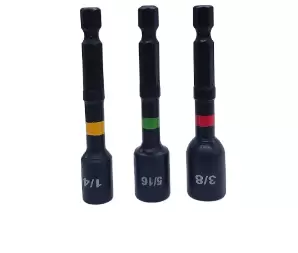
Why torque transfer efficiency defines fastening performance
The primary function of an impact nut setter is to transfer rotational energy and impact force from the driver to the fastener. In real-world applications, this process is affected by multiple factors:
- Contact geometry between socket and fastener
- Material hardness and elasticity of the tool
- Impact energy absorption and transmission efficiency
- Wear behavior under repeated loading cycles
In high-speed impact tools operating at 2000–3000 RPM with repeated torque pulses, inefficient energy transfer leads to:
- Reduced fastening torque at the fastener interface
- Increased slippage and rounding of nut edges
- Higher energy consumption for the same fastening result
- Accelerated wear of both tool and fastener
A well-designed impact nut setter minimizes these losses by optimizing both geometry and material properties.
Material engineering: balancing hardness and toughness
One of the most critical design considerations for an impact nut setter is material selection. The tool must withstand high impact loads while maintaining dimensional stability over time.
Key material properties include:
- Hardness typically in the range of HRC 58–62 for wear resistance
- Toughness to absorb repeated impact without cracking
- Fatigue resistance under cyclic loading
- Surface hardness uniformity to prevent localized wear
Shangfeng Machinery utilizes advanced cold forging processes, which refine grain structure at the microscopic level. Compared to traditional machining, cold forging results in:
- Higher material density
- Improved fatigue resistance
- Better impact load distribution
- Reduced internal defects
This is particularly important in impact applications where micro-cracks can propagate rapidly under repeated stress cycles.
Socket precision and dimensional tolerance
The geometric accuracy of an impact nut setter directly affects torque transmission and fastener protection.
Typical precision requirements include:
- Dimensional tolerance within ±0.01–0.02 mm
- Tight fit between socket and fastener to minimize play
- Consistent hex profile to distribute load evenly across contact surfaces
Poor dimensional control leads to uneven stress distribution, which causes:
- Premature wear of socket edges
- Rounding or stripping of fasteners
- Increased vibration during operation
High-precision manufacturing ensures that torque is evenly distributed, reducing localized stress concentration and extending both tool and fastener life.
Surface treatment and wear resistance
In industrial fastening environments, wear is inevitable. However, the rate of wear can be significantly reduced through proper surface treatment.
Common treatments include:
- Black oxide coating for corrosion resistance
- Phosphate coating to reduce friction and improve lubrication retention
- Heat treatment processes to achieve uniform hardness
For high-duty applications, advanced coatings can improve surface durability and reduce friction, which contributes to:
- Lower heat generation during operation
- Reduced energy loss
- Improved long-term dimensional stability
Shangfeng’s production system integrates high-precision heat treatment and surface finishing processes, ensuring consistent performance across large production batches.
Impact vs standard nut setters: performance differences
While standard nut setters are suitable for low-speed applications, impact nut setters are specifically designed for high-torque, high-frequency environments.
Key differences include:
Standard nut setters:
- Designed for continuous rotational torque
- Lower resistance to impact stress
- Suitable for manual or low-speed power tools
Impact nut setters:
- Reinforced structure for impact load absorption
- Optimized for torque pulses rather than continuous rotation
- Compatible with impact drivers delivering high peak torque
Using standard nut setters in impact applications often results in rapid tool failure, while properly engineered impact nut setters maintain performance under extreme conditions.
Application scenarios: where performance matters most
The value of a high-quality impact nut setter becomes evident in demanding industrial environments.
In automotive assembly lines:
- High-speed fastening requires consistent torque output
- Tool failure leads to production delays
- Precision is critical to avoid fastener damage
In construction and steel structure installation:
- High-torque fastening is required for structural integrity
- Tools must withstand outdoor and harsh conditions
- Durability directly impacts project timelines
In appliance and electronics manufacturing:
- Fastening accuracy affects product quality
- High-volume production demands long tool lifespan
- Reduced vibration improves operator control and efficiency
Lifecycle cost analysis: beyond initial price
While lower-cost tools may appear attractive initially, their total cost of ownership is often significantly higher.
Factors influencing lifecycle cost include:
- Tool replacement frequency
- Downtime caused by tool failure
- Fastener damage and rework costs
- Energy efficiency of torque transfer
A high-performance impact nut setter reduces these costs by delivering:
- Longer service life
- Stable performance over time
- Reduced failure rate in production lines
Manufacturing capability as a quality determinant
The performance of an impact nut setter is directly linked to manufacturing capability.
Shangfeng Machinery’s strengths include:
- Advanced automated production lines for consistency
- Cold forging processes for superior material properties
- High-precision inspection systems for quality control
- Compliance with DIN and ANSI standards for global compatibility
These factors ensure that each tool meets strict industrial requirements and performs reliably across different applications.
Conclusion: small component, critical impact
The impact nut setter may be a small component within a fastening system, but its influence on overall performance is significant.
From torque transfer efficiency to wear resistance and operational stability, every aspect of its design affects productivity and reliability.
For high-demand industrial applications, selecting a well-engineered impact nut setter is not just a tooling decision—it is a critical factor in achieving consistent, high-quality assembly outcomes.