
 EN
EN


In industrial fastening applications, especially where impact drivers are used, tool failure is rarely caused by a single factor. It is typically the result of cumulative stress from high torque, repeated shock loading, and material fatigue. Under these conditions, a standard screwdriver bit often fails prematurely through torsional fracture or tip deformation.
The hex impact bit is specifically engineered to withstand these extreme operating conditions. Its performance is defined not only by hardness but also by its ability to absorb impact energy, resist wear, and maintain dimensional stability over thousands of fastening cycles.
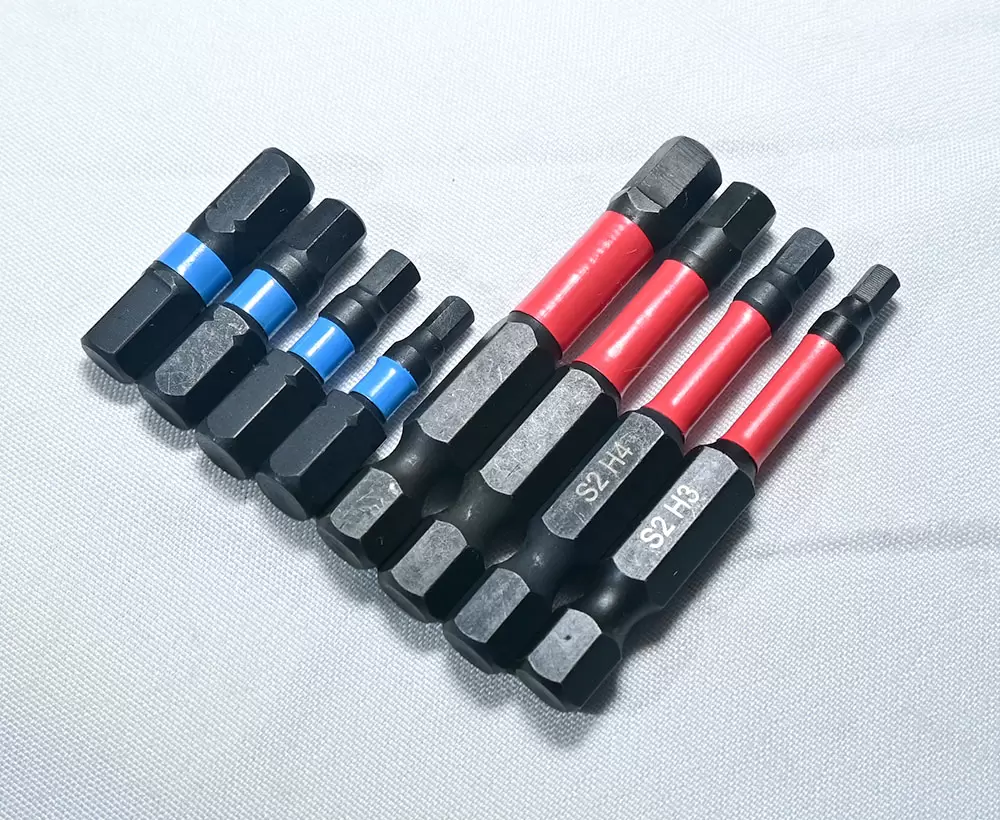
Torque transmission and structural design
The defining feature of a hex impact bit is its ability to transfer high torque without structural failure. In impact driver applications, torque output can exceed 150–250 Nm depending on the tool specification.
To handle this, hex impact bits are designed with:
A hexagonal shank (typically 1/4 inch standard) for stable power transfer
Reinforced torsion zones that absorb shock loads
Optimized geometry to reduce stress concentration at the tip
Unlike standard bits, which are rigid and prone to snapping, impact-rated bits incorporate controlled flexibility. This allows the bit to twist slightly under load, distributing stress along its length rather than concentrating it at a single failure point.
Material composition and heat treatment
Material selection is one of the most critical factors determining hex impact bit performance. Industrial-grade bits are typically manufactured from S2 alloy steel or modified Cr-Mo (chromium-molybdenum) steel.
These materials are chosen for their balance between hardness and toughness. After cold forging, the bits undergo controlled heat treatment processes, including quenching and tempering.
Typical hardness ranges are:
HRC 58–62 at the tip for wear resistance
HRC 52–56 in the torsion zone for flexibility
This gradient hardness structure is essential. A fully hardened bit would be brittle and prone to fracture, while a softer bit would deform under load. The combination ensures both durability and impact resistance.
Shangfeng Machinery utilizes Taiwan cold forging processes to achieve high-density grain structures, improving fatigue resistance and overall mechanical strength.
Wear resistance and tip precision
In high-frequency fastening operations, bit wear directly affects fastening accuracy and efficiency. Worn bits lead to cam-out, where the bit slips out of the screw head, damaging both the fastener and the tool.
Precision machining ensures tight tolerances between the bit tip and screw recess. For example, dimensional accuracy is typically controlled within ±0.02 mm to ensure proper fit.
Surface treatments such as black oxide or phosphate coating are commonly applied to:
Improve corrosion resistance
Reduce friction during insertion
Enhance surface hardness
These treatments extend tool life, especially in environments where moisture or chemical exposure is present.
Impact fatigue and lifecycle performance
Impact drivers generate repeated high-frequency torque pulses, often exceeding several thousand impacts per minute. This creates cyclic stress that can lead to fatigue failure over time.
Hex impact bits are designed to withstand this by:
Using refined grain structures from cold forging
Maintaining controlled hardness gradients
Optimizing torsion zones to absorb repeated stress
In industrial testing conditions, high-quality impact bits can endure tens of thousands of fastening cycles without significant performance degradation.
This durability is critical in assembly lines, construction sites, and maintenance operations where tool replacement frequency directly affects productivity.
Application scenarios in industrial environments
Hex impact bits are widely used in:
Construction and structural fastening where high torque is required
Automotive assembly lines involving repetitive fastening operations
Heavy equipment maintenance where fasteners may be corroded or over-tightened
Woodworking and furniture assembly requiring consistent fastening performance
In these scenarios, tool reliability directly impacts work efficiency and overall operational cost.
Standard compliance and manufacturing consistency
To ensure compatibility and performance consistency, hex impact bits are typically manufactured according to international standards such as DIN and ANSI.
These standards define:
Shank dimensions
Tip geometry
Material performance requirements
Manufacturers like Shangfeng Machinery integrate automated production lines and high-precision inspection equipment to maintain consistent quality across large production volumes. This consistency is essential for global supply chains where reliability must be maintained across different markets and applications.
Conclusion
The performance of a hex impact bit is determined by a combination of material engineering, structural design, and manufacturing precision.
In high-torque, high-frequency fastening environments, standard bits are not sufficient. Impact-rated bits provide the durability, flexibility, and wear resistance required to maintain consistent performance over extended operational cycles.
As industrial fastening applications continue to demand higher efficiency and reliability, the role of engineered hex impact bits becomes increasingly critical in ensuring both productivity and tool longevity.